


 Create Document

 Adobe PDF
 Microsoft Word
Lease Agreements By Type (7)
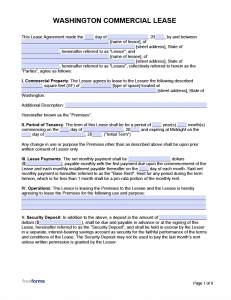 Commercial Lease Agreement: A rental contract specifically defining the conditions (and terms) a landlord and business entity tenant must fulfill. Commercial Lease Agreement: A rental contract specifically defining the conditions (and terms) a landlord and business entity tenant must fulfill.
Download: PDF, Word (.docx) |
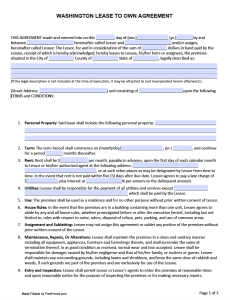 Lease to Own Agreement: A contract permitting tenants to pay into a property purchase while renting, then close upon completion. Lease to Own Agreement: A contract permitting tenants to pay into a property purchase while renting, then close upon completion.
Download: PDF |
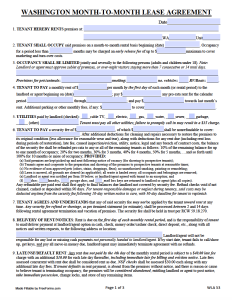 Month-to-Month Lease: A rental agreement with a term that renews once a month and terminates with 30 days’ notice. Month-to-Month Lease: A rental agreement with a term that renews once a month and terminates with 30 days’ notice.
Download: PDF |
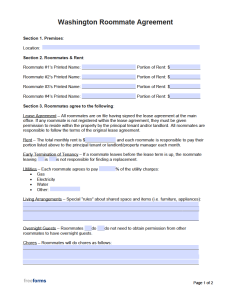 Roommate Agreement: The contract defining how two or more cohabitants will occupy and pay for a rental property accordingly. Roommate Agreement: The contract defining how two or more cohabitants will occupy and pay for a rental property accordingly.
Download: PDF, Word (.docx) |
|
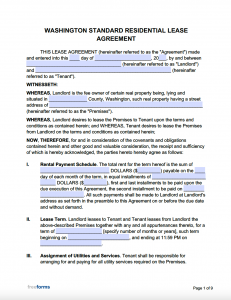
Standard Lease Agreement Download: PDF, Word (.docx) |
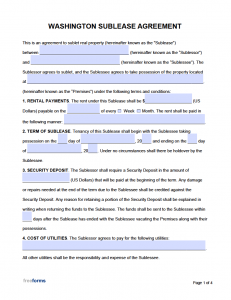 Sublease Agreement: This form documents the specifics of a sublandlord’s rental to a subtenant while adhering to the master lease. Sublease Agreement: This form documents the specifics of a sublandlord’s rental to a subtenant while adhering to the master lease.
Download: PDF, Word (.docx) |
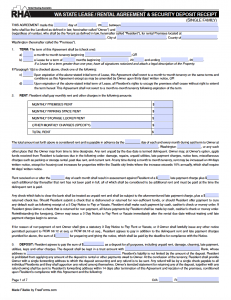 Washington RHA Version: A lease, from the Rental Housing Association, presenting the provisions necessary specifically to rent a single-family dwelling. Washington RHA Version: A lease, from the Rental Housing Association, presenting the provisions necessary specifically to rent a single-family dwelling.
Download: PDF |
Additional Forms
Satellite Dish Installation Addendum: Explicitly establishes the rules and regulations concerning the installation of a satellite dish on the premises.
Septic Tank Addendum: Describes the type of septic system on the property with the conditions of use in detail.
Smoke & Carbon Monoxide Detector: Presents the types of detectors operating on the property, as well as tenant maintenance obligations.
Smoke-Free Addendum: Documents the regulations governing smoking on or near the property while requiring acknowledgment.
Required Landlord Disclosures
1.) Contact Information: Washington mandates that leasing paperwork list the landlord’s name and address as well as any authorized managing officials for the building (§ 59.18.060).
2.) Non-Refundable Fees: Landlords must disclose any payments they will not return, but are due at signing nonetheless (§ 59.18.285).
3.) Security Deposit Receipt: Confirmation of the landlord’s receipt of the security as well as the name and address of the financial institution holding it (§ 59.18.270).
4.) Move-in Checklist: Landlords provide tenants with a list of structural defects on the property that is revieable and disputable by the tenant (§ 19.18.260).
5.) Mold: Literature regarding the dangers of indoor mold must be present in the lease documents or posted on the property for the tenant to review. The information about unsafe molds must contain the education materials provided by the Department of Health(§ 59.18.060).
6.) Lead-Based Paint (40 CFR § 745.113): Homes that were constructed before 1978 require an additional federal disclosure should there be any chance for lead-based paint on the property. The disclosed information will inform of the precautions to take with the substance and any health complications that could arise from exposure.
7.) Fire Protection and Evacuation: Properties (excluding single-family occupancy) require written materials on fire safety (e.g., building evacuation procedures, fire alarm systems, sprinkler systems) (§ 59.18.060).
When is Rent Due?
Grace Period: Landlords wait 5 days after the due date before applying late fees and then serve a pay-or-quit notice upon nonpayment ((Wash. Rev. Code § 59.18.170(2)), (Wash. Rev. Code § 59.18.057)).
Unpaid Rent: Landlords can present nonpaying tenants with a 14-day pay-or-quit notice once rent is late (Wash. Rev. Code § 59.18.057).
Late Fees
While Washington does not govern late fees for residential written leases, it does limit how much landlords may charge in mobile home parks:
- 2% in the first month
- 3% for the second month late (consecutively)
- 5% of the monthly rent for the third month late and all after. (Wash. Rev. Code § 59.20.060(2)).
NSF Fees
Security Deposit Maximum ($)
The State of Washington does not regulate the maximum that a landlord requires as a security deposit; however, any lease requiring security must be in writing ((Wash. Rev. Code §§ 59.18.260), (Wash. Rev. Code § 59.18.270)).
Security Deposit Return
Returning to Tenant: Washington state explicitly obligates landlords to return the security deposit amount within 30 days of termination (Wash. Rev. Code § 59.18.280).
Itemized List: Landlords document deposit deductions in detail, and provide this report together with the balance within 30 days of termination (Wash. Rev. Code § 59.18.280).
Landlord’s Right To Enter
Landlord’s only enter during reasonable hours with consent after:
- Giving 2 days’ notice (in writing) for maintenance or repairs, they must perform
- Providing 1 day notice to show the property to future tenants, so long as they do not abuse this right (Wash. Rev. Code § 59.18.150).
Emergency Entry: Landlords do not have an obligation to seek consent during emergencies before entering to respond (Wash. Rev. Code § 59.18.150).
Absence
Repair and Deduct
Whenever landlords do not respond or do not remedy certain violations:
- If a professional is necessary, then tenants deduct 2 months’ rent or less to pay for qualifying repairs that landlords neglect
- Tenants can deduct up to 1 month’s rent for a lawful repair that does not require a professional, accordingly (Wash. Rev. Code § 59.18.070), (Wash. Rev. Code § 59.18.060), (Wash. Rev. Code §59.18.100)
When a Tenant Terminates (early)
Duty to Mitigate: While abandoning tenants may still be liable for missing rent, Washington requires landlords to mitigate the loss (Wash. Rev. Code § 59.18.310).
Domestic Violence: Victims, in Washington state, may terminate by notice within 90 days of the last domestic violence incident, but must provide:
- Court order, specifically an order of protection
- A signed statement from a “qualified” party (e.g., police, victim’s counselor) (Wash. Rev. Code § 59.18.575).
Active Military: Current federal law requires landlords to accept 30 days’ termination notice from service members under orders to relocate (50 USC § 3955).
Landlord Noncompliance: Generally, tenants may not terminate over noncompliance unless through the courts or under hazardous conditions (e.g., gas leak) ((Wash. Rev. Code § 59.18.060), (RCW § 59.18.070)).
Landlord Harassment: Washington does not generally allow tenants to terminate over harassment, but does hold landlords liable for damages, attorney’s fees, and up to $100 for each violation after receiving notice (Wash. Rev. Code § 59.18.150)
Inhabitability: Tenants may terminate a lease over serious habitability issues if the appropriate notice does not prompt landlord action; for example;
- Tenants provide 24 hours’ notice of defective condition whenever the habitability issue significantly impacts their ability to obtain hot or cold water, electricity, heat, or is life-threatening
- A tenant must give 72 hours’ notice of defective condition to repair or a quit notice for issues such as the property’s refrigerator, oven, or plumbing.
- Tenants deliver a 10-day notice of defective conditions for all other issues that significantly impact their health or safety (Wash. Rev. Code § 59.18.070).
Is an Oral Lease enforceable?
Renewing a Lease
Unclaimed Property
Landlords provide notice to tenants of their possessions on the property, then, in the absence of an answer, may dispose or sell such property:
- After 45 days, if the property is worth more than $250
- After 10 days, if the property is worth less than $250 (Wash. Rev. Code § 59.18.310).
 Chat with a Lawyer