


 Create Document
 Adobe PDF
 Microsoft Word
Lease Agreements By Type (7)
|
Download: PDF |
|
Download: PDF, Word (.docx) |
|
Download: PDF, Word (.docx) |
|
Download: PDF, Word (.docx) |
|
Download: PDF |
|
Standard Lease Agreement Download: PDF, Word (.docx) |
|
Download: PDF, Word (.docx) |
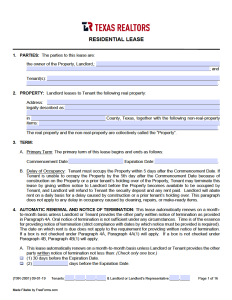
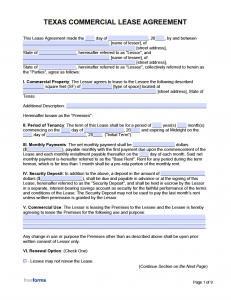 Commercial Lease Agreement
Additional Forms
Agreement Between Brokers for Residential Leases: If real estate brokers are involved in a transaction concerning the rental of a residential property, they may implement this agreement to further clarify the amount each party is entitled to.
Inventory & Condition Form: This is a document that records the condition of a rental property prior to moving in and after moving out.
Pet Agreement: Landlords may carry out this addendum in order to establish how many pets a tenant is allowed to possess within a particular property, as well as the code of conduct that must be followed regarding the animal(s).
Residential Real Estate Listing Agreement (Exclusive Right to Lease): Brokers should execute this contract in order to gain the exclusive rights to rent a landlord’s property.
Required Landlord Disclosures
1.) Identification of the Landlord or Authorized Personnel: The lease paperwork presents the names and addresses of the owners as well as the property managers and agents (§ 8.92.201).
2.) Lead-Based Paint(42 U.S. Code § 4852d): Homes built before 1978 have the potential for a presence of lead, thus they include disclosures of the lead-based paint risks.
3.) Parking and Towing Rules: The parking guidelines, as well as consequences for noncompliance, must be part of the lease when applicable (§ 8.92.013).
4.) Landlord Liability and Tenant Remedy: A disclosure informing tenants of landlord responsibilities and when they have a right to issue a 7-day notice to repair or quit or rent deduction for repair (§ 8.92.056).
5.) Property Removal of Deceased Tenants: In the unfortunate event that a tenant should pass away within the duration of the leasing period, the landlord will be required to allow a designated party entry to obtain personal belongings and security deposit. The landlord is obligated to send, via certified mail, notice to the designated individual to appear to gather the personal items within thirty (30) days of mailing the notification (§ 8.92.014.5).
When is Rent Due?
Grace Period: While Texas does not regulate grace periods, it requires landlords ro wait 2 days before applying late fees accordingly (TX Prop § 92.019).
Unpaid Rent: Landlords, in Texas, use tenant-status to decide on their response to nonpayment;
- A 3-day notice to pay or quit for a first-time rent default
- A 3-day notice to pay-or-quit or 3-day notice to vacate specifically to tenants with multiple defaults (Tex. Prop. Code § 92.019), (Tex. Prop. Code § 24.005).
Late Fees
Landlords document late fees in the lease if they expect to collect on them; additionally:
- The late fee must be 12 percent or less of the rent whenever the landlord has less than 4 units.
- The late fee may not be more than (specifically) 10 percent if the landlord has more than 4 units (Tex. Prop. Code § 92.019).
NSF Fees
Security Deposit Maximum ($)
Security Deposit Return
Returning to Tenant: Texas explicitly obligates landlords to return the security deposit within 30th day after tenants vacate. (TX Prop § 92.103).
Itemized List: Unless rent is “owed at surrender,” landlords only deduct for valid damages while submiting an account sheet (TX Prop § 92.104).
Landlord right to Enter
Standard Entry: Outside of lease provisions, Texas does not govern a landlord’s right to enter the property (Texas State Law Library).
Emergency Entry: Texas generally allows landlords to enter without consent during emergencies requiring immediate response to protect property or safety (Texas State Law Library).
Absence
Repair and Deduct
When a Tenant Terminates (early)
Duty to Mitigate: Texas explicitly states that landlords have a “duty to mitigate damages” whenever tenants abandon property (TX Prop § 91.006).
Domestic Violence: Tenants give 30-day notice with documentation from the courts or from a licensed health-care/mental health provider or advocate (TX Prop § 92.016)
Active Military: Federal law permits military service members to terminate their lease whenever they must move to comply with assignments (50 USC 3955).
Landlord Noncompliance: Tenants may terminate whenever landlords are noncompliant with specific health and safety requirements (e.g., rekeying locks after turnover) (TX Prop § 92.164), (Tex. Prop. Code § 91.006(a)).
Landlord Harassment: Generally, tenants must work with the courts for relief rather than terminating the lease over retaliation or harassment. (TX Prop § 92.333)
Inhabitability: So long as the tenants are compliant with the lease, they may issue a notice to repair or quit when landlords neglect the duty of maintaining habitability (TX Prop § 92.056).
Are Oral Leases enforceable?
Renewing a Lease
Unclaimed Property
Texas does not explicitly require property storage after abandonment; however:
- They must follow lease provisions, such as how to determine when the tenant abandons personal property.
- Landlords may remove property from the premises for proper storage, especially when mitigating damages to re-rent the premises.
- They must send the tenant a 30-day notice regarding their property in the premises before sales or disposal. (Tex. Prop. Code § 54.044(d)): (Tex. Prop. Code § 54.045).
 Chat with a Lawyer