


 Create Document

 Adobe PDF
Lease Agreements By Type (7)
 Commercial Lease Agreement: Highlights the commitment to rent commercial space specifically (and often exclusively) for business activity. Commercial Lease Agreement: Highlights the commitment to rent commercial space specifically (and often exclusively) for business activity.
Download: PDF, Word (.docx) |
 HCVP Lease Agreement: Landlords use this lease whenever tenants are in the Housing Choice Voucher Program for public housing (includes the HUD Tenancy Addendum (52641A) and Owner Certification Form). HCVP Lease Agreement: Landlords use this lease whenever tenants are in the Housing Choice Voucher Program for public housing (includes the HUD Tenancy Addendum (52641A) and Owner Certification Form).
Download: PDF |
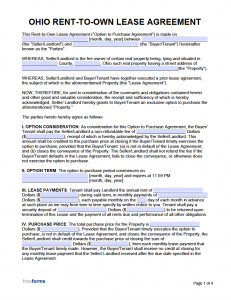 Lease to Own Agreement: An agreement that solidifies property rental conditions and terms, as well as the specifics and opportunity to purchase it. Lease to Own Agreement: An agreement that solidifies property rental conditions and terms, as well as the specifics and opportunity to purchase it.
Download: PDF, Word (.docx) |
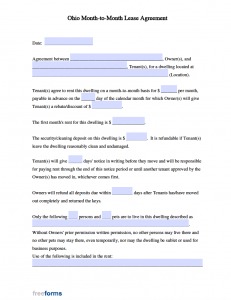 Month-to-Month Lease: Involves a contract to rent a home with an allowance to end without consequence with advance notice of thirty (30) days. Month-to-Month Lease: Involves a contract to rent a home with an allowance to end without consequence with advance notice of thirty (30) days.
Download: PDF |
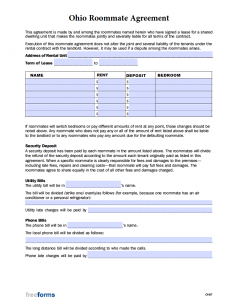 Roommate Agreement: Specifies terms to a lease where an individual rents a room and a property’s common areas for a particular time period and price. Roommate Agreement: Specifies terms to a lease where an individual rents a room and a property’s common areas for a particular time period and price.
Download: PDF |
|
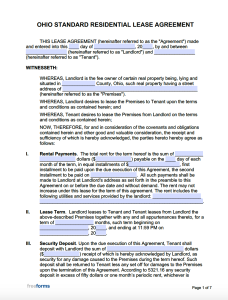
Standard Lease Agreement Download: PDF, Word (.docx) |
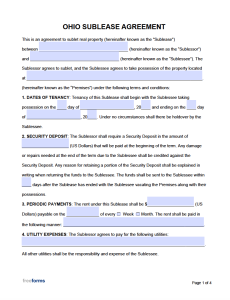 Sublease Agreement: Completes a written guarantee for a current renter to re-rent a domicile to an alternate tenant for an agreed-upon payment schedule. Sublease Agreement: Completes a written guarantee for a current renter to re-rent a domicile to an alternate tenant for an agreed-upon payment schedule.
Download: PDF, Word (.docx) |
Required Landlord Disclosures
1.) Lead-based Paint (40 CFR § 745.113): Compliant with the federal enforcement regulation, applicable to pre-1978 properties, that specifically warns of the dangers of lead exposure from paint.
2.) Landlord/Agent Identity (Ohio Rev. Code § 5321.18): Ohio explicitly expects landlords, agents, and the owners to identify themselves and provide their contact information in the lease.
When is Rent Due?
Grace Period: Ohio assumes rent is due according to the lease; therefore, landlords issue notice to pay immediately upon nonpayment (OHRS R.C. 1923.04(A)).
Unpaid Rent: Landlords serve tenants with a 3-Day Notice to Leave the property, then pursue legal eviction if necessary (OHRS R.C. 1923.04(A)).
Late Fees
NSF Fees
Security Deposit Maximum ($)
Security Deposit Return
Returning to Tenants: Landlords, in Ohio, have 30 days or less to return the tenant’s security once the the lease terminates. (R.C. 5321.16(B)).
Itemized List: Whenever Ohio landlords deduct for repairs, more severe than wear and tear, or deduct missing rent from security, they must provide an listing of each deduction. (R.C. 5321.16(B))
Landlord’s Right to Enter
Standard Entry: Landlords must gain tenant consent to enter; therefore, they often give reasonable notice (24 hours) (OHRC 5321.04(A)(8)).
Emergency Entry: Landlords enter the property whenever an emergency demands immediate action (OHRC 5321.04(A)(8)).
Absence
Repair and deduct
Tenants submit notice of the violation significantly interfering with their possession, then, with a lack of remedy:
- Deposit the rent with the county clerk
- Pursue the matters accordingly with the issue in court
(OHRC 5321.07).
When a Tenant terminates (early)
Duty to Mitigate: Landlords must minimize or control losses resulting from tenant abandonment and must mitigate accordingly (F. Ent., Inc. v. Kentucky Fried Chicken Corp., 47 Ohio St.2d 154 (1976)).
Active Military: Service members deliver 30 days’ notice to terminate a lease whenever they must move to accommodate their orders (50 USC 3955).
Domestic Violence: Ohio does not explicitly set laws allowing domestic violence victims to terminate prematurely; such actions require court action (OHRC 5321).
Landlord Noncompliance: While unable to independently terminate a lease, tenants deposit the rent with the courts to seek a cure or termination after a 30-day notice ((OHRC 5321.07), (OHRC 5321.08)).
Landlord Harassment: Tenants must be able to prove constructive eviction whenever they terminate over harassment (OHRC 5321.04).
Inhabitability: Tenants deliver a notice in writing specifically requiring landlords to remedy code violations before seeking court aid ((OHRC 5321.07(A)), (OHRC 5321.07)).
 Chat with a Lawyer