


 Create Document

 Adobe PDF
State Laws
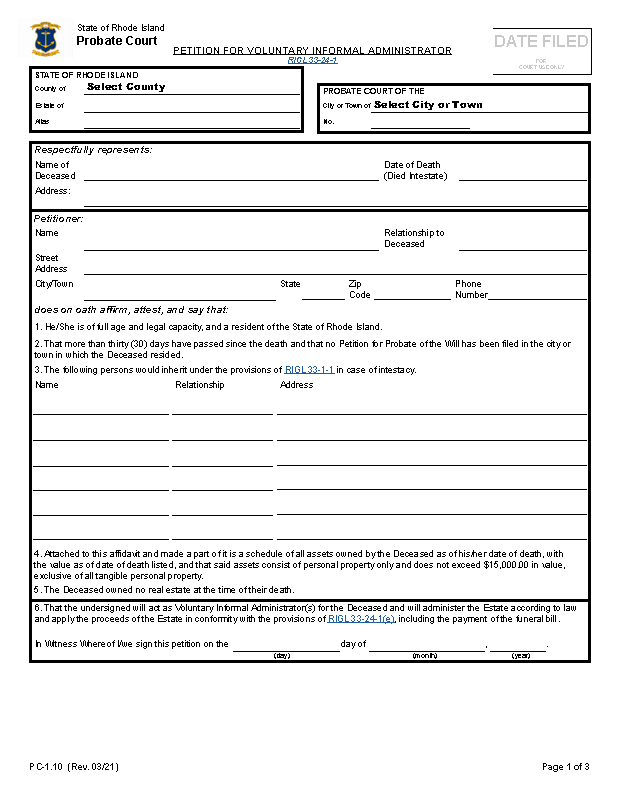
- Maximum Amount: $15,000, the value of the estate’s personal property subject to a probate inventory, excluding the decedent’s tangible personal property. Real estate is not covered.[1]
- Signing Requirements: The statement must be verified by oath or affirmation (sworn).[2]
- Where to File: With the probate court of the city or town where the decedent resided; the filing fee is $30.[3]
- When to File: 30 days after death.[4]
- Survivor Requirements: A rightful heir must survive the decedent by at least 120 hours (5 days).[5]
Rightful Heirs (Hierarchy)
If the decedent did not have a will, the beneficiary hierarchy is as follows:
- Spouse: After the estate’s expenses and debts are paid, the surviving spouse receives the entire remaining balance, even if the decedent left children or other descendants.[6]
- No Spouse, Children: If there is no surviving spouse, the remaining personal property passes to the decedent’s children and their descendants under Rhode Island’s intestacy law, with a deceased child’s share passing to that child’s descendants.[7][8]
How to File a Small Estate
Step 1 – Wait 30 Days
At least 30 days must pass after the decedent’s death before the statement may be filed.[9]
Step 2 – Confirm the Estate Qualifies
The estate must consist entirely of personal property valued, excluding tangible personal property, at $15,000 or less, with no real estate and no pending petition for letters.[10]
Step 3 – Prepare and Verify the Statement
Prepare the statement required by § 33-24-1 and verify it by oath or affirmation. The filer must be a relative or interested party of full age and legal capacity who resides in Rhode Island.[11]
Step 4 – File With the Municipal Probate Court
File the statement with the probate court of the city or town where the decedent resided, with the statutory filing fee.[12]
Step 5 – Collect, Pay, and Distribute the Property
After the judge’s review, the clerk issues a certification appointing the voluntary administrator. Collect the personal property, pay funeral and administration expenses and the decedent’s debts, and distribute the entire remaining balance to the surviving spouse. If there is no surviving spouse, distribute the balance under Rhode Island’s intestacy laws.[13][14]
Sample
Download: PDF
Sources
- R.I. Gen. Laws § 33-24-1
- R.I. Gen. Laws § 33-24-1
- R.I. Gen. Laws § 33-24-1
- R.I. Gen. Laws § 33-24-1
- R.I. Gen. Laws § 33-1-13
- R.I. Gen. Laws § 33-24-1
- R.I. Gen. Laws § 33-24-1
- R.I. Gen. Laws § 33-1-10
- R.I. Gen. Laws § 33-24-1
- R.I. Gen. Laws § 33-24-1
- R.I. Gen. Laws § 33-24-1
- R.I. Gen. Laws § 33-24-1
- R.I. Gen. Laws § 33-24-1
- R.I. Gen. Laws § 33-1-10
 Chat with a Lawyer