


 Create Document

 Adobe PDF
 Microsoft Word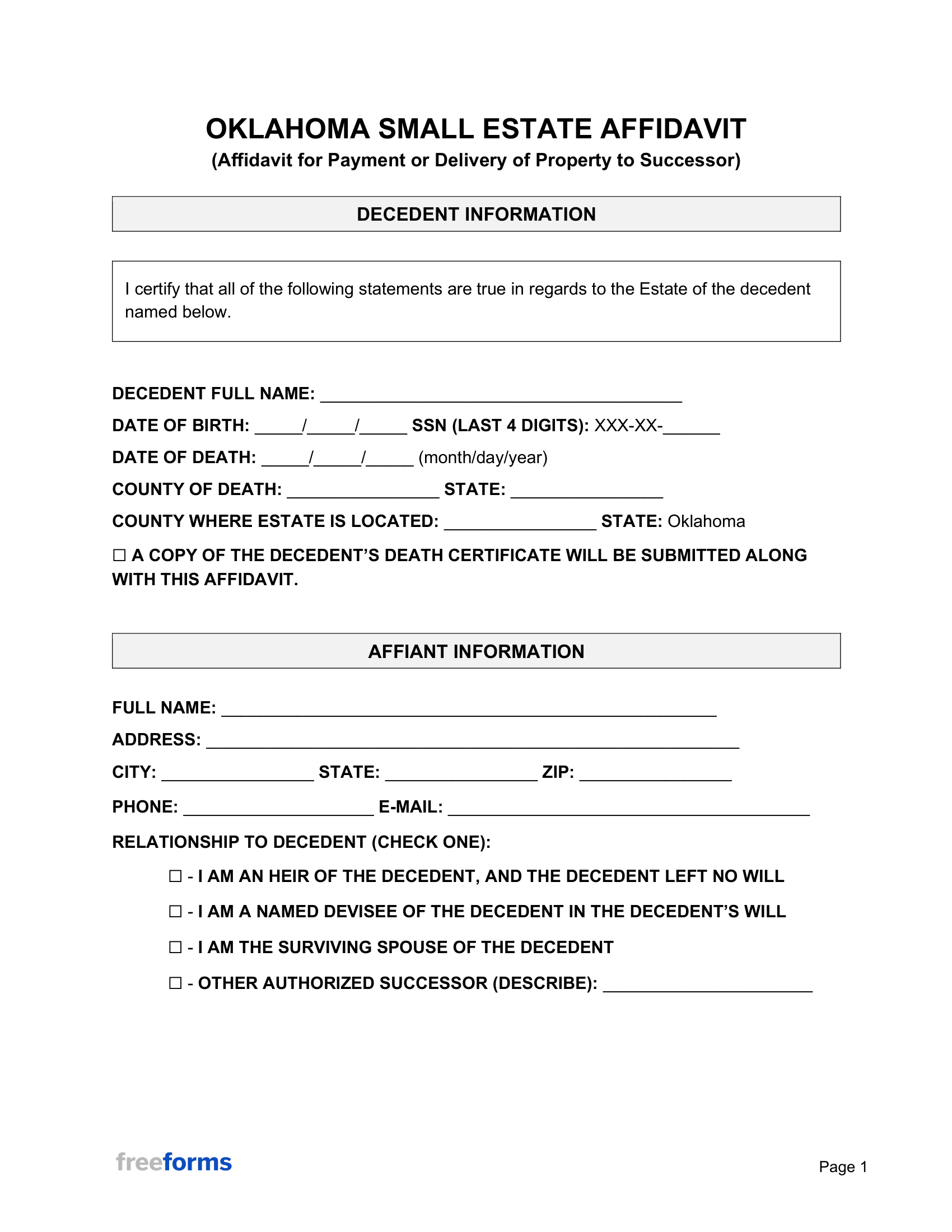
State Laws
- Maximum Amount: $50,000, the fair market value of the decedent’s Oklahoma property subject to will or intestate succession, less liens and encumbrances.[1]
- Signing Requirements: Sworn before a notary public by the claiming successors.[2]
- Where to File: Not filed with the court, presented directly to the person or institution holding the asset.[3]
- When to File: 10 days after death.[4]
- Survivor Requirements: Oklahoma does not use a 120-hour survival rule.[5]
Rightful Heirs (Hierarchy)
If the decedent did not have a will, the beneficiary hierarchy is as follows:
- Spouse: If there are no children, parents, siblings, or descendants of siblings, the surviving spouse receives the entire estate. If there are no children but a parent or sibling survives, the spouse receives all property the couple acquired by joint effort during the marriage, plus one-third of the rest. If all of the decedent’s children are also the spouse’s, the spouse receives one-half of the estate. If any child is from another relationship, the spouse receives one-half of the jointly acquired property and an equal share with the children in the rest.[6]
- No Spouse, Children: The share not passing to the spouse goes to the decedent’s children and descendants by representation. If there is no surviving spouse, the children and descendants inherit the estate.[7]
How to File a Small Estate
Step 1 – Wait 10 Days
At least 10 days must pass after the decedent’s death before the affidavit may be used.[8]
Step 2 – Confirm the Estate Qualifies
The fair market value of the decedent’s Oklahoma property subject to will or intestate succession (less liens and encumbrances) must be $50,000 or less, and no personal representative may be pending or appointed.[9]
Step 3 – Identify the Successors
Determine who is entitled to the property under the will or by intestate succession (Okla. Stat. tit. 84, § 213).[10]
Step 4 – Prepare and Notarize the Affidavit
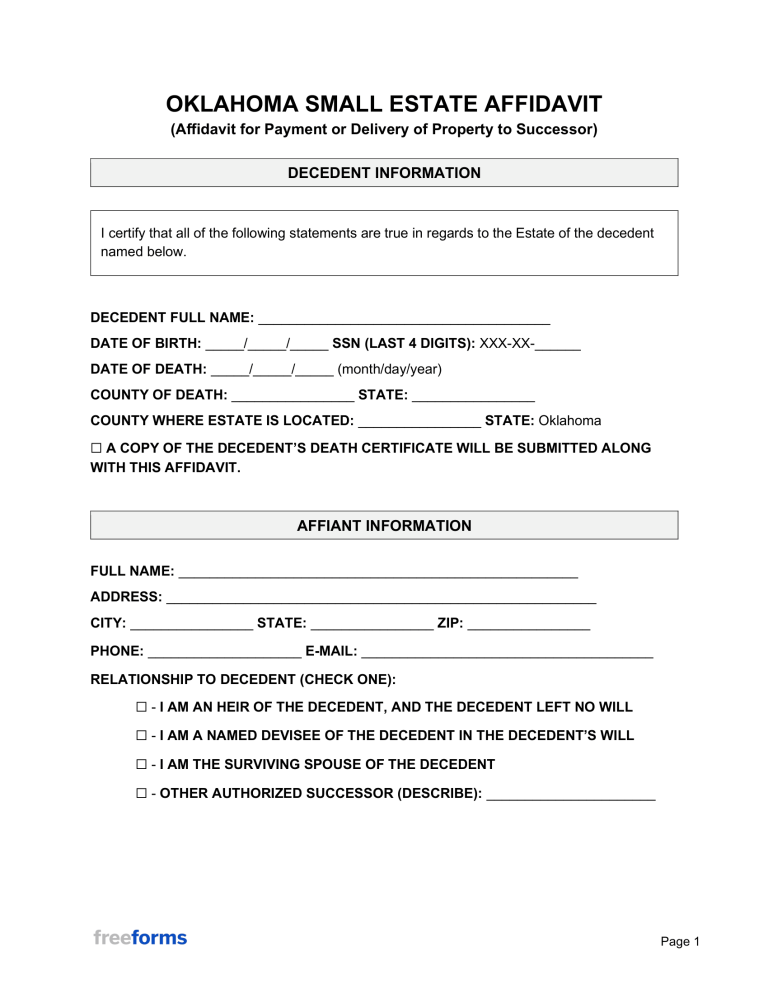
Prepare the affidavit stating that the value condition is met, that no probate is pending, that the successors are entitled in the stated proportions, and that taxes and debts are paid or provided for, then have all claiming successors sign it before a notary public.[11]
Step 5 – Present the Affidavit to the Asset Holder
Present the notarized affidavit to the bank, employer, transfer agent, or other holder of the property to obtain payment or delivery.[12]
Sample
Sources
- Okla. Stat. tit. 58 § 393
- Okla. Stat. tit. 58 § 393
- Okla. Stat. tit. 58 § 393
- Okla. Stat. tit. 58 § 393
- Okla. Stat. tit. 58 § 1001
- Okla. Stat. tit. 84 § 213(B)
- Okla. Stat. tit. 84 § 213(B)
- Okla. Stat. tit. 58 § 393
- Okla. Stat. tit. 58 § 393
- Okla. Stat. tit. 84 § 213(B)
- Okla. Stat. tit. 58 § 393
- Okla. Stat. tit. 58 § 393
 Chat with a Lawyer