


 Create Document

 Adobe PDF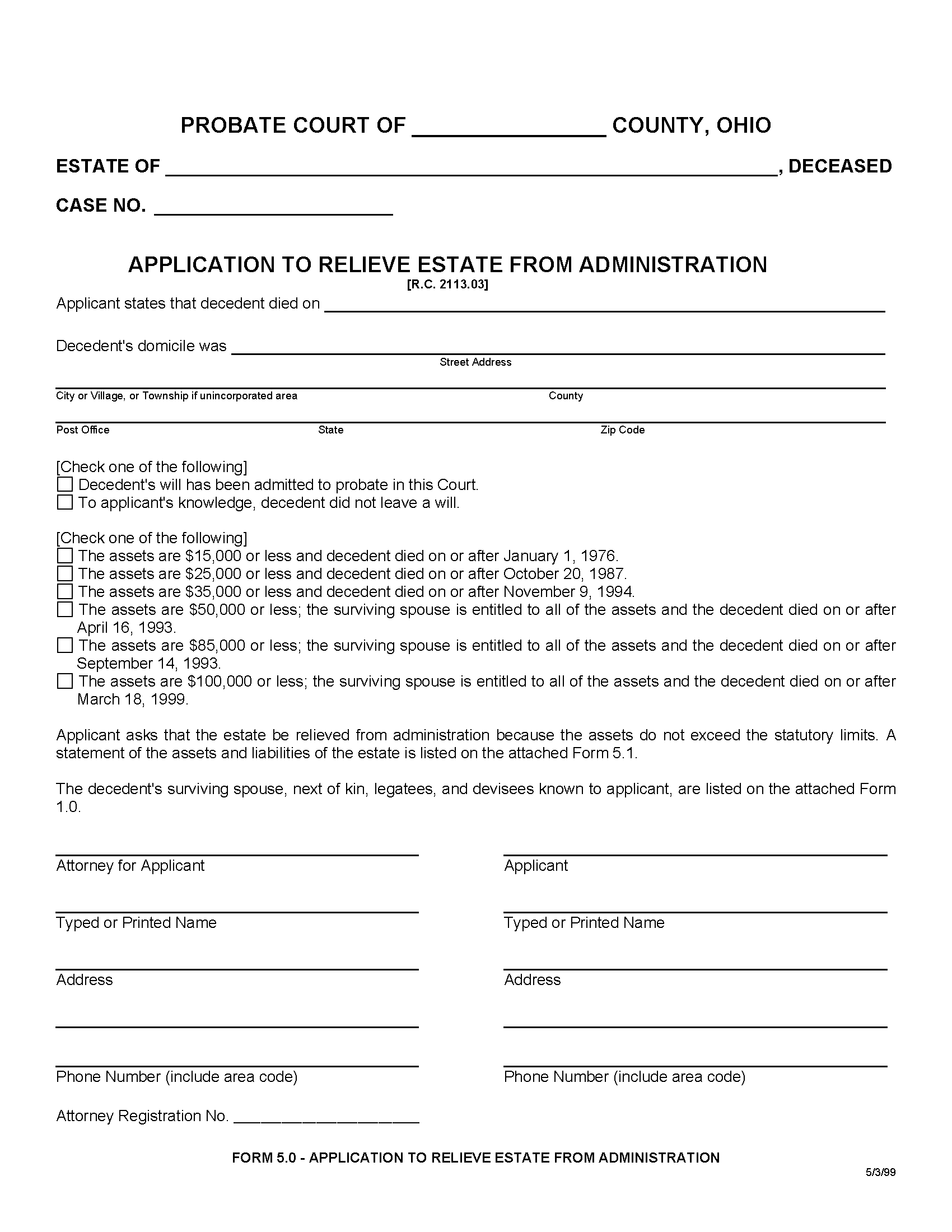
State Laws
- Maximum Amount: $35,000 for release from administration, or $100,000 if the surviving spouse is the sole heir or beneficiary.[1]
- Signing Requirements: The summary release application is signed before a notary public or a deputy clerk of the probate court; both procedures are filed on the statewide probate forms.[2]
- Where to File: With the probate court of the county where the decedent was domiciled.[3]
- When to File: No statutory waiting period.[4]
- Survivor Requirements: A rightful heir must survive the decedent by at least 120 hours (5 days).[5]
Rightful Heirs (Hierarchy)
If the decedent did not have a will, the beneficiary hierarchy is as follows:
- Spouse: The surviving spouse receives the entire estate if the decedent left no children, if all of the decedent’s children are also the spouse’s, or if there is more than one child and the spouse is the parent of at least one (that first share of $60,000 is more than the $35,000 small estate limit). If there is exactly one child from another relationship, the spouse receives the first $20,000 plus one-half of the rest. If there is more than one child and the spouse is the parent of none of them, the spouse receives the first $20,000 plus one-third of the rest.[6]
- No Spouse, Children: The share not passing to the spouse goes to the children equally, with a deceased child’s share passing to that child’s descendants. If there is no surviving spouse, the children take the entire estate.[7]
How to File a Small Estate
Step 1 – Confirm the Estate Qualifies
Confirm the estate is worth $35,000 or less (or $100,000 or less if the surviving spouse is the sole heir or beneficiary), or that it qualifies for summary release based on the spouse’s allowance and funeral expenses.[8][9][10]
Step 2 – Complete the Correct Form
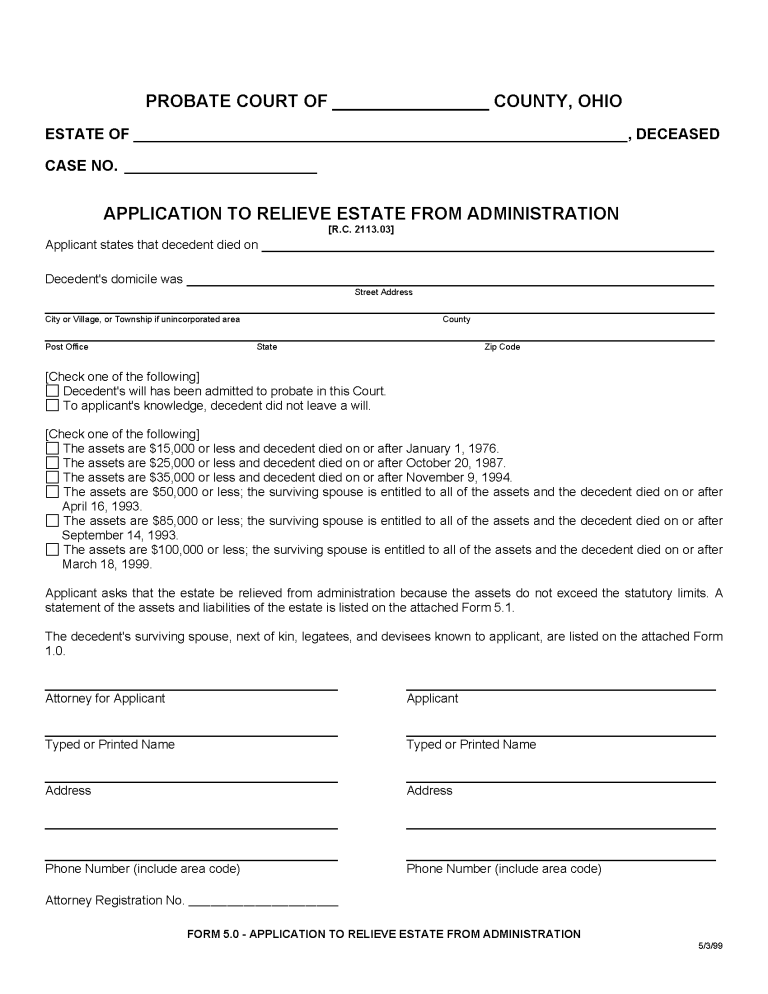
For release from administration, complete the Application (Form 5.0).[11][12]
Step 3 – Provide Notice or Acknowledge Before a Notary
For release from administration, give the surviving spouse and heirs the notice the court directs; for summary release, sign the application before a notary or deputy clerk.[13][14]
Step 4 – File With the Probate Court
File with the probate court of the decedent’s county and pay the fee.[15]
Step 5 – Obtain the Court’s Order
The court enters an order relieving the estate from administration (Form 5.6) or granting summary release (Form 5.11) and authorizing the transfer of the assets.[16][17]
Sample
Download: PDF
Sources
- Ohio Rev. Code § 2113.03(A)
- Ohio Rev. Code § 2113.031(C)(2)(c)
- Ohio Rev. Code § 2113.03(B)
- Ohio Rev. Code § 2113.03(B)
- Ohio Rev. Code § 2105.32
- Ohio Rev. Code § 2105.06
- Ohio Rev. Code § 2105.06
- Ohio Rev. Code § 2113.03(A)
- Ohio Rev. Code § 2113.031
- Ohio Rev. Code § 2106.13
- Ohio Rev. Code § 2113.03
- Ohio Rev. Code § 2113.031
- Ohio Rev. Code § 2113.03(B)
- Ohio Rev. Code § 2113.031
- Ohio Rev. Code § 2113.03(B)
- Ohio Rev. Code § 2113.03(B)
- Ohio Rev. Code § 2113.031
 Chat with a Lawyer