


 Create Document

 Adobe PDF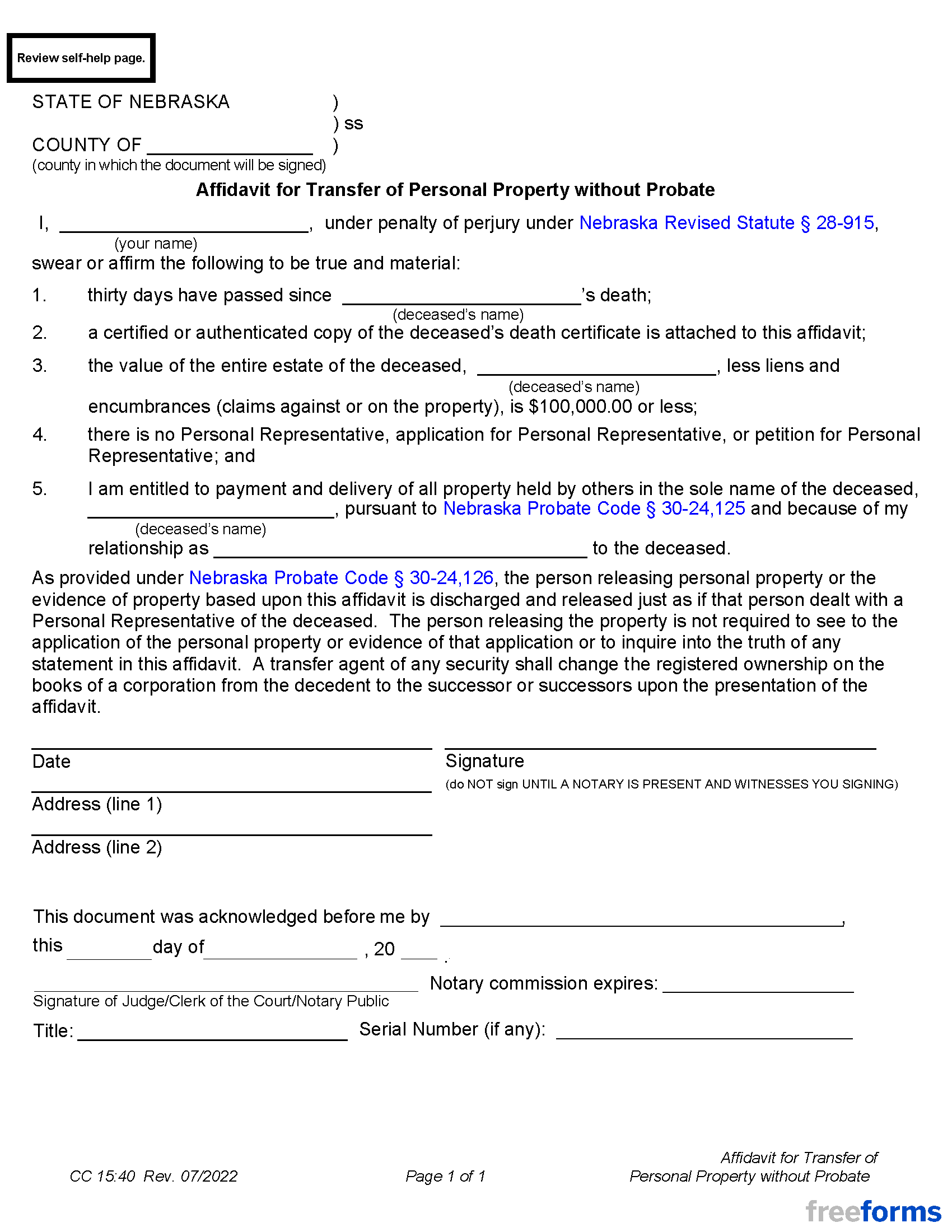
State Laws
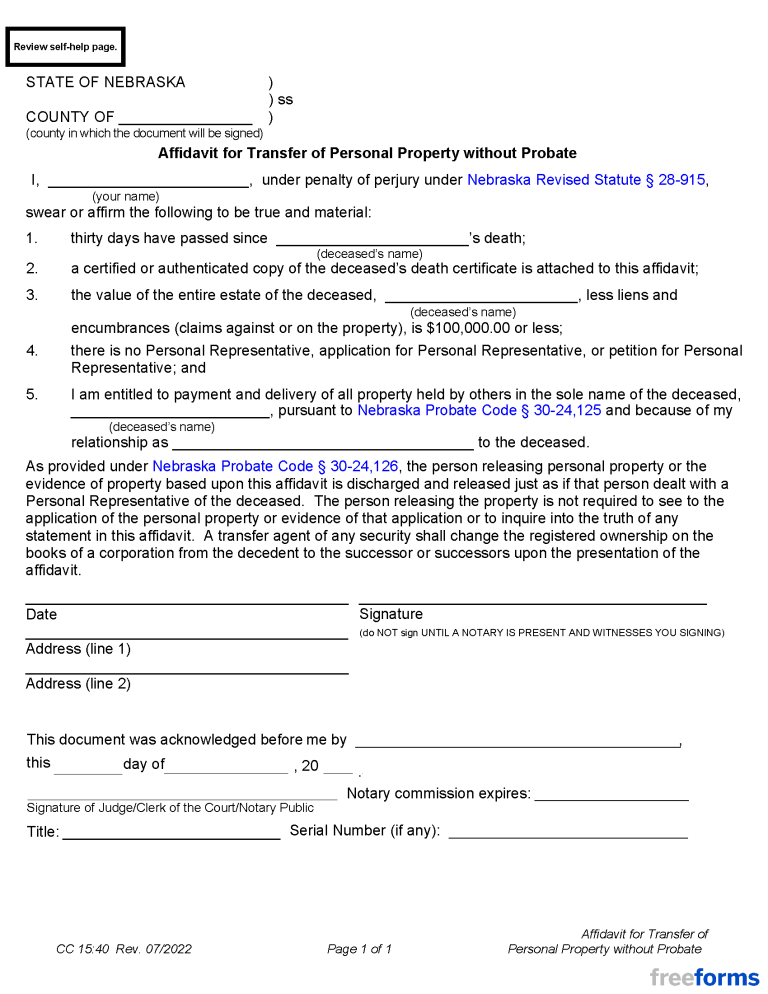
- Maximum Amount: $100,000, the value of all personal property in the estate, wherever located, less liens and encumbrances.[1]
- Signing Requirements: Sworn or affirmed under penalty of perjury, before a notary.[2]
- Where to File: The personal property affidavit is presented directly to each holder of the asset (not filed with a court).[3]
- When to File: 30 days after death.[4]
- Survivor Requirements: A rightful heir must survive the decedent by at least 120 hours (5 days).[5]
Rightful Heirs (Hierarchy)
If the decedent did not have a will, the beneficiary hierarchy is as follows:
- Spouse: The surviving spouse receives the entire estate if the decedent left no descendants, or if all of the decedent’s descendants are also the spouse’s, because the spouse’s guaranteed first share equals or exceeds the $100,000 small estate limit.[6] If the decedent left descendants from another relationship, the spouse receives one-half, and those descendants share the other half.[7]
- No Spouse, Children: If there is no surviving spouse, the estate passes to the decedent’s descendants, equally if they are all of the same degree, otherwise by representation.[8]
How to File a Small Estate
Step 1 – Wait 30 Days
At least 30 days must pass after the decedent’s death before either small-estate affidavit may be used.[9]
Step 2 – Confirm the Correct Procedure Qualifies
For personal property, the net value after liens and encumbrances must be $100,000 or less, and no personal representative may be pending or appointed.[10]
Step 3 – Complete the Correct Form
Complete Form CC 15:40 for personal property, or Form CC 15:41 for Nebraska real property, and obtain a certified copy of the death certificate.[11]
Step 4 – Sign Before a Notary
Sign the personal-property affidavit before a notary.[12]
Step 5 – Present or Record the Affidavit
Present the personal-property affidavit and death certificate to each asset holder.[13]
Sample
Download: PDF
Sources
- Neb. Rev. Stat. § 30-24,125(a)(1)
- Neb. Rev. Stat. § 30-24,125(a)(4)
- Neb. Rev. Stat. § 30-24,125
- Neb. Rev. Stat. § 30-24,125(a)(2)
- Neb. Rev. Stat. § 30-2304
- Neb. Rev. Stat. § 30-2302
- Neb. Rev. Stat. § 30-2302(4)
- Neb. Rev. Stat. § 30-2303(1)
- Neb. Rev. Stat. § 30-24,125(a)(2)
- Neb. Rev. Stat. § 30-24,125(a)(1)
- Neb. Rev. Stat. § 30-24,125
- Neb. Rev. Stat. § 30-24,125(a)(4)
- Neb. Rev. Stat. § 30-24,125
 Chat with a Lawyer