


 Create Document

 Adobe PDF
State Laws
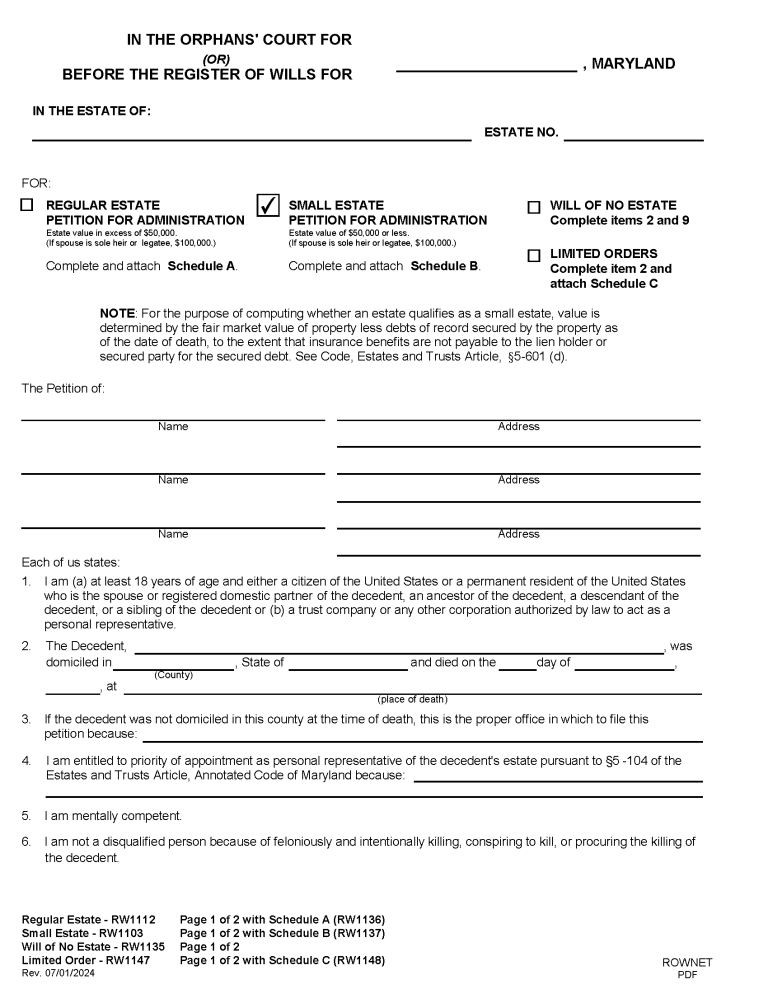
- Maximum Amount: $50,000, the value of property subject to administration in Maryland (or $100,000 or less if the surviving spouse is the sole heir or legatee), valued at fair market value less debts of record secured by the property, as of the date of death.[1]
- Signing Requirements: The petition is signed under penalties of perjury (Form RW1103).
- Where to File: With the Register of Wills for the county (or Baltimore City) of the decedent’s domicile.[2][3]
- When to File: No waiting period (it must be filed before an initial account is filed in a regular administration).[4]
- Survivor Requirements: A rightful heir must survive the decedent by 30 full days.[5]
Rightful Heirs (Hierarchy)
If the decedent did not have a will, the beneficiary hierarchy is as follows:
- Spouse: The surviving spouse receives the entire estate unless the decedent left a minor child. If there is a minor child, the spouse receives one-half. (When the decedent left only adult descendants from another relationship, the spouse’s first share of $100,000 is more than the $50,000 small estate limit, so the spouse still receives everything.)[6]
- No Spouse, Children: A minor child shares one-half of the estate with the decedent’s other descendants. If there is no surviving spouse, the descendants inherit the entire estate.[7]
How to File a Small Estate
Step 1 – Confirm the Estate Qualifies
The property subject to administration in Maryland must be $50,000 or less (or $100,000 or less if the surviving spouse is the sole heir or legatee), valued at fair market value less secured debts of record.[8]
Step 2 – Complete the Petition (Form RW1103)
Complete the Petition for Administration of Small Estate, with Schedule B, listing the known property and values, known creditors and claim amounts, and any pending legal proceedings involving the decedent.[9]
Step 3 – Attach Supporting Documents
Attach the death certificate, the original will (if any), and the list of interested persons.[10]
Step 4 – File With the Register of Wills
Sign the petition under penalties of perjury and file it with the Register of Wills for the county (or Baltimore City) of the decedent’s domicile, with the applicable fee.[11][12]
Step 5 – Give Notice and Distribute
Give the required notice to creditors and unknown heirs, pay allowable claims, and distribute the remaining property to those entitled.[13]
Sample
Download: PDF
Sources
- Md. Code, Est. & Trusts § 5-601(a), (c), (d)
- Md. Code, Est. & Trusts § 5-602
- Md. Code, Est. & Trusts § 5-103(a)
- Md. Code, Est. & Trusts § 5-601
- Md. Code, Est. & Trusts § 3-110(a)
- Md. Code, Est. & Trusts § 3-102(a)–(c)
- Md. Code, Est. & Trusts § 3-103
- Md. Code, Est. & Trusts § 5-601(a), (c)
- Md. Code, Est. & Trusts § 5-602(2)–(4)
- Md. Code, Est. & Trusts § 5-201(b)(5)(i)
- Md. Code, Est. & Trusts § 5-602
- Md. Code, Est. & Trusts § 5-103(a)
- Md. Code, Est. & Trusts § 5-603(a), (b)
 Chat with a Lawyer