


 Create Document

 Adobe PDF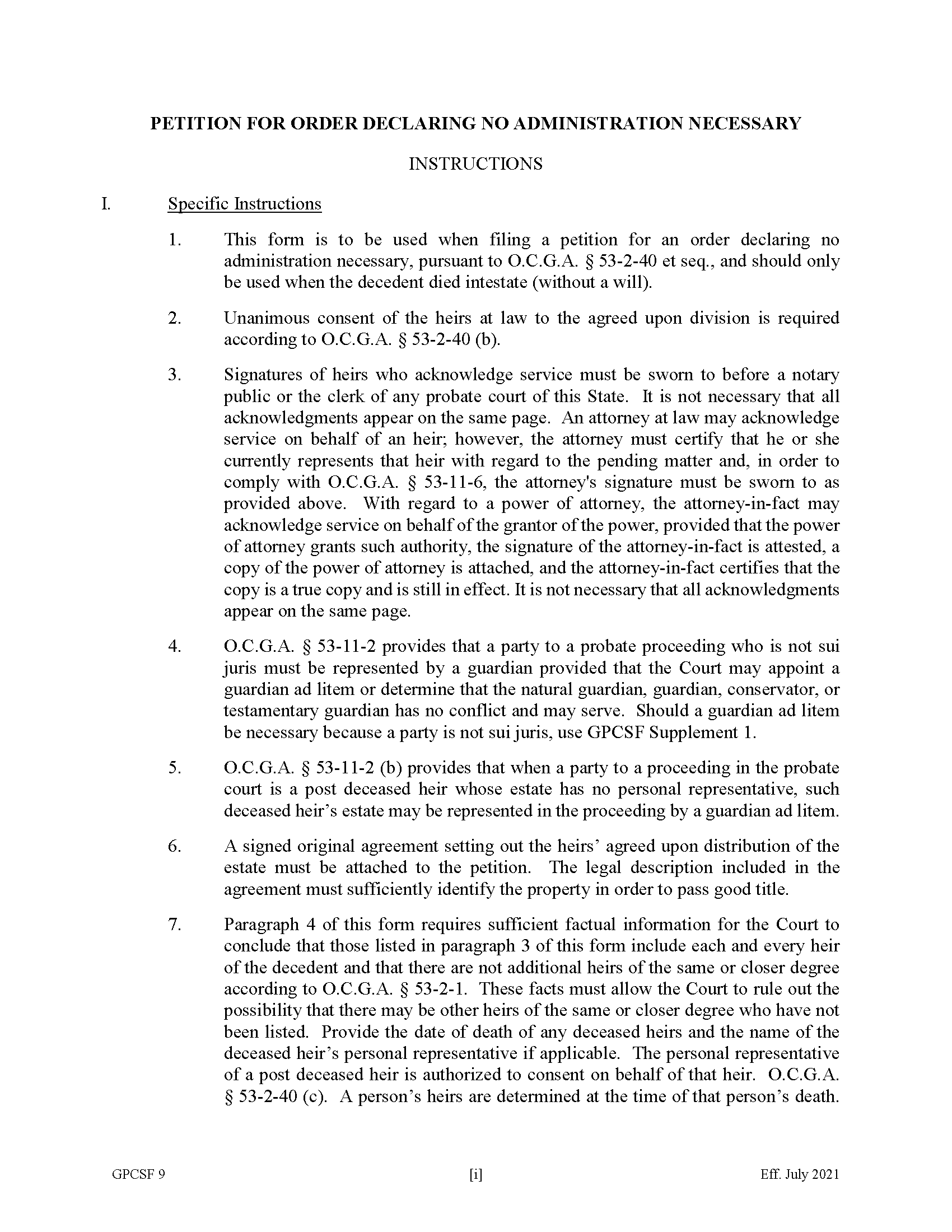
State Laws
- Maximum Amount: No dollar limit for an order declaring no administration necessary; the separate bank-account affidavit is capped at $15,000.[1][2]
- Signing Requirements: Must be signed with signatures attested by a notary public or probate court clerk; the bank affidavit must be sworn and notarized.[3][4]
- Where to File: The petition is filed in the Probate Court of the county of the decedent’s domicile.[5]
- When to File: No waiting period for the no-administration petition. (For the bank affidavit, if no qualifying relative claims the account within 45 days of death, the bank may instead apply up to $15,000 toward funeral and last-illness expenses.)[6][7]
- Survivor Requirements: Georgia has no fixed 120-hour survival rule. Under the Simultaneous Death Act, where an interest depends on survival and survival cannot be established, the property is disposed of as provided by that Act.[8]
Rightful Heirs (Hierarchy)
If the decedent did not have a will, the beneficiary hierarchy is as follows:
- Spouse: If the decedent left no children or other descendants, the surviving spouse receives the entire estate.[9]
- No Spouse, Children: If the decedent left a spouse and children, they share the estate equally, but the spouse’s share is never less than one-third, so with three or more children, the spouse takes one-third, and the children divide the rest. A deceased child’s share passes to that child’s descendants. If there is no surviving spouse, the children take the entire estate equally.[10]
How to File a Small Estate
Step 1 – Confirm the Estate Qualifies
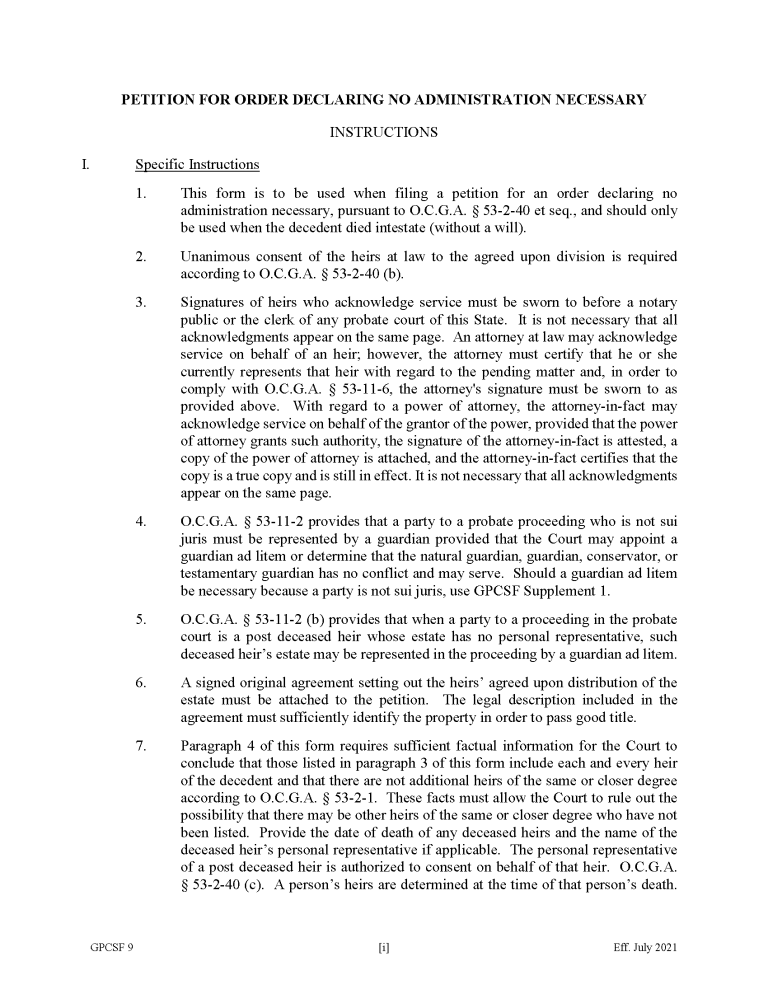
The decedent must have died without a will, no personal representative may have been appointed, the estate must owe no debts (or all creditors consent or are served), and all heirs must agree on the division of the estate.[11]
Step 2 – Prepare the Heirs’ Agreement
Have all heirs sign a written agreement setting out how the estate will be divided, with signatures attested by a notary public or a probate court clerk.[12]
Step 3 – Complete GPCSF 9
Complete the Petition for Order Declaring No Administration Necessary (GPCSF 9), attaching the signed heirs’ agreement.[13]
Step 4 – File With the Probate Court
File the verified petition in the Probate Court of the county of the decedent’s domicile, with the filing fee.[14]
Step 5 – Obtain the Order
Absent objection, the court enters an order declaring no administration necessary. (For bank funds only, an heir may instead use the sworn § 7-1-239 affidavit to collect a deceased intestate depositor’s account, up to $15,000, directly from the bank.)[15][16]
Sample
Download: PDF
- O.C.G.A. § 53-2-40
- O.C.G.A. § 7-1-239
- O.C.G.A. § 53-2-40(b)
- O.C.G.A. § 7-1-239
- O.C.G.A. § 53-2-40(a)
- O.C.G.A. § 53-2-40
- O.C.G.A. § 7-1-239
- O.C.G.A. § 53-10-3
- O.C.G.A. § 53-2-1(c)
- O.C.G.A. § 53-2-1(c)
- O.C.G.A. § 53-2-40(b)
- O.C.G.A. § 53-2-40(b)
- O.C.G.A. § 53-2-40
- O.C.G.A. § 53-2-40(a)
- O.C.G.A. § 53-2-40
- O.C.G.A. § 7-1-239
 Chat with a Lawyer