


 Create Document

 Adobe PDF
 Microsoft Word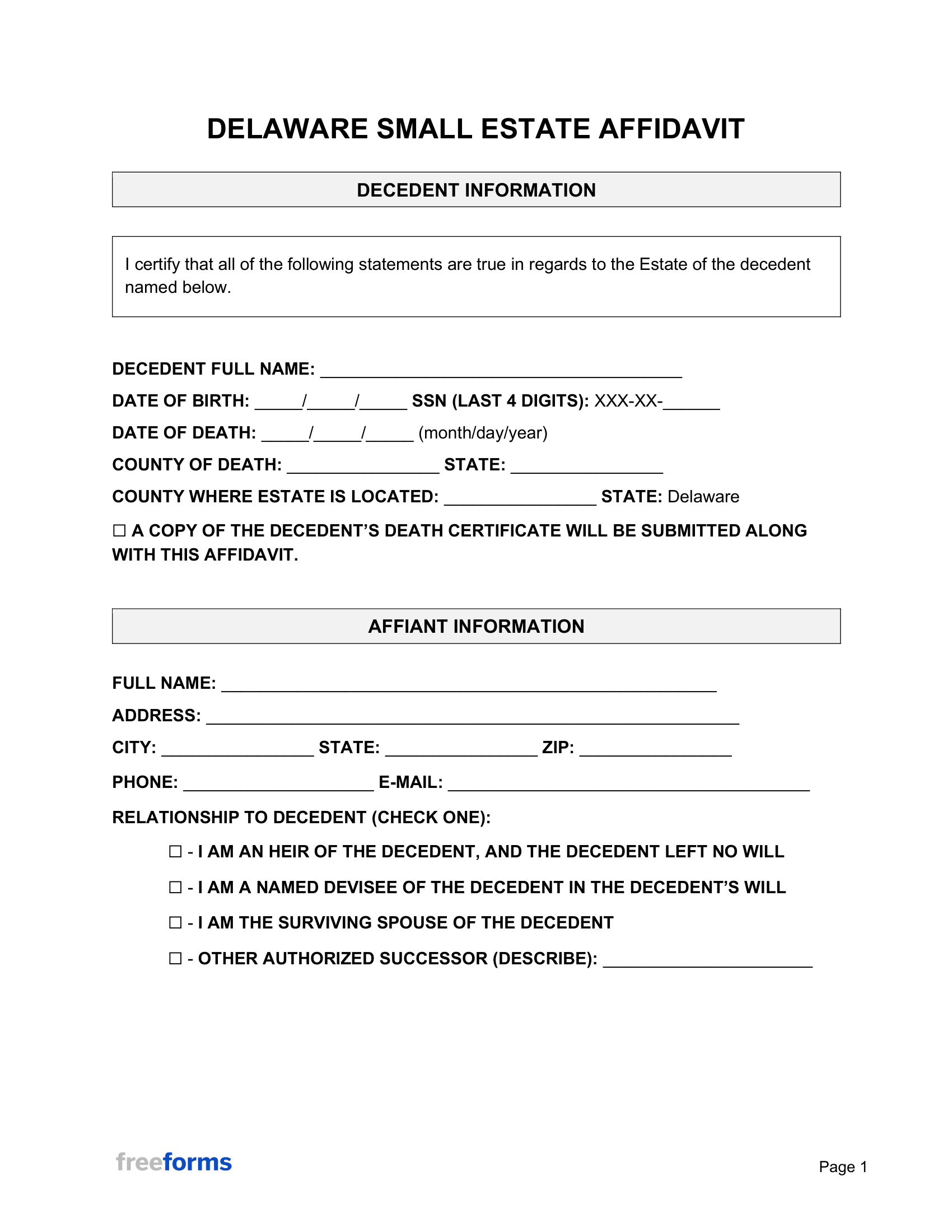
State Laws
- Maximum Amount: $30,000 in personal property. Jointly owned (survivorship) property and certain property are excluded, and the decedent must have owned no Delaware real estate, either solely or as a tenant in common.[1][2]
- Signing Requirements: Executed under oath (sworn) through the Register of Wills.[3]
- Where to File: With the Register of Wills in the county where the decedent resided, New Castle, Kent, or Sussex.[4]
- When to File: 30 days after death.[5]
- Survivor Requirements: A rightful heir must survive the decedent by at least 120 hours (5 days).[6]
Rightful Heirs (Hierarchy)
If the decedent did not have a will, the beneficiary hierarchy is as follows:
- Spouse: The surviving spouse receives the entire estate if the decedent left no children, or only children shared with the spouse. Delaware guarantees the spouse the first $50,000 of the personal estate.[7] If the decedent left children from another relationship, the spouse receives one-half of the personal estate, and those children share the other half.[8]
- No Spouse, Children: If there is no surviving spouse, the children share the estate equally, with a deceased child’s share passing to that child’s descendants.[9]
How to File a Small Estate
Step 1 – Wait 30 Days
At least 30 days must pass after the decedent’s death before the affidavit may be used.[10]
Step 2 – Confirm the Estate Qualifies
The decedent’s personal property covered by the statute must be $50,000 or less, the decedent must have owned no Delaware real estate, and no personal representative may have been appointed or be pending. Known debts and the surviving spouse’s statutory allowance must be paid, provided for, waived, or otherwise resolved as the statute permits.[11][12]
Step 3 – Obtain and Complete the Affidavit Through the Register of Wills
Obtain and complete the affidavit in the decedent’s county, attesting to all required conditions.[13]
Step 4 – Swear to the Affidavit Under Oath
Execute the affidavit under oath before the Register of Wills.[14]
Step 5 – Present the Affidavit to Collect and Distribute the Property
Present the sworn affidavit to the persons or institutions holding the decedent’s personal property to collect and distribute it to those entitled, in the statutory order of preference.[15]
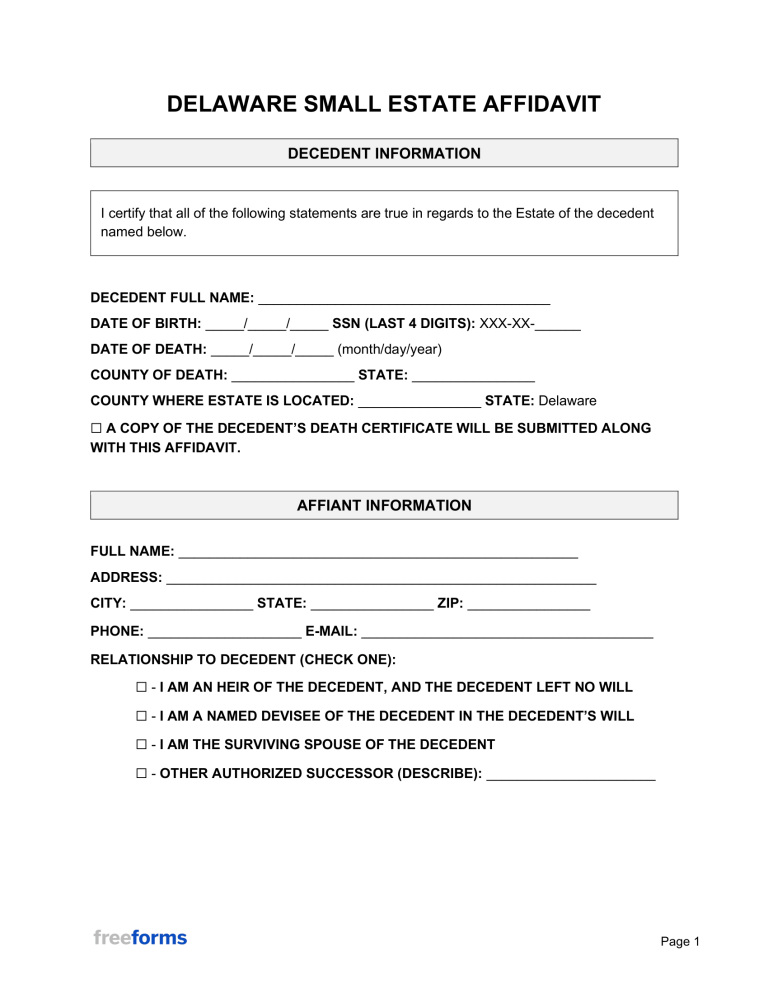
Sample
Sources
- Delaware General Assembly (House Bill 333)
- 12 Del. C. § 2306
- 12 Del. C. § 2306
- 12 Del. C. § 2306
- 12 Del. C. § 2306
- 12 Del. C. § 504
- 12 Del. C. § 502
- 12 Del. C. § 502(4)
- 12 Del. C. § 503
- 12 Del. C. § 2306
- Delaware General Assembly (House Bill 333)
- 12 Del. C. § 2306
- 12 Del. C. § 2306
- 12 Del. C. § 2306
- 12 Del. C. § 2306
 Chat with a Lawyer