


 Create Document

 Adobe PDF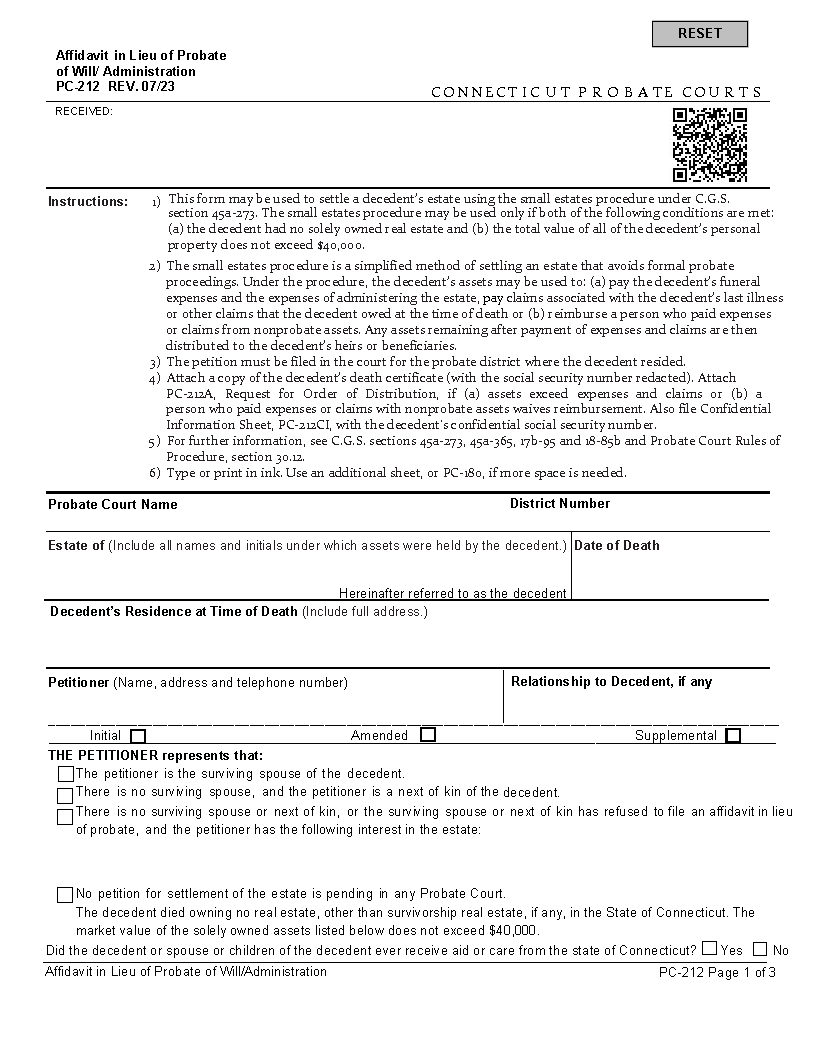
State Laws
- Maximum Amount: $40,000 in solely owned personal property, and the decedent must have owned no solely owned Connecticut real estate. Property that passes by survivorship or beneficiary designation does not count toward the limit.[1]
- Signing Requirements: The affidavit is signed under penalty of false statement.[2]
- Where to File: With the Probate Court for the district where the decedent resided at death.[3]
- When to File: No specific pre-filing waiting period is required, but the court will not issue its decree until 30 days after sending the affidavit to the Department of Administrative Services.[4]
- Survivor Requirements: Connecticut has no fixed 120-hour survival period.[5]
Rightful Heirs (Hierarchy)
If the decedent did not have a will, the beneficiary hierarchy is as follows:
- Spouse: The surviving spouse receives the entire estate if the decedent left no children, or only children shared with the spouse. Connecticut guarantees the spouse a first share of at least $100,000, which is more than the $40,000 small estate limit.[6] If the decedent left children from another relationship, the spouse receives one-half, and those children share the other half.[7]
- No Spouse, Children: If there is no surviving spouse, the children share the estate equally, with a deceased child’s share passing to that child’s descendants.[8]
How to File a Small Estate
Step 1 – Confirm the Estate Qualifies
The decedent must have owned no solely owned Connecticut real estate, and solely owned personal property must total $40,000 or less (survivorship and beneficiary-designated assets are not counted).[9]
Step 2 – Complete Form PC-212
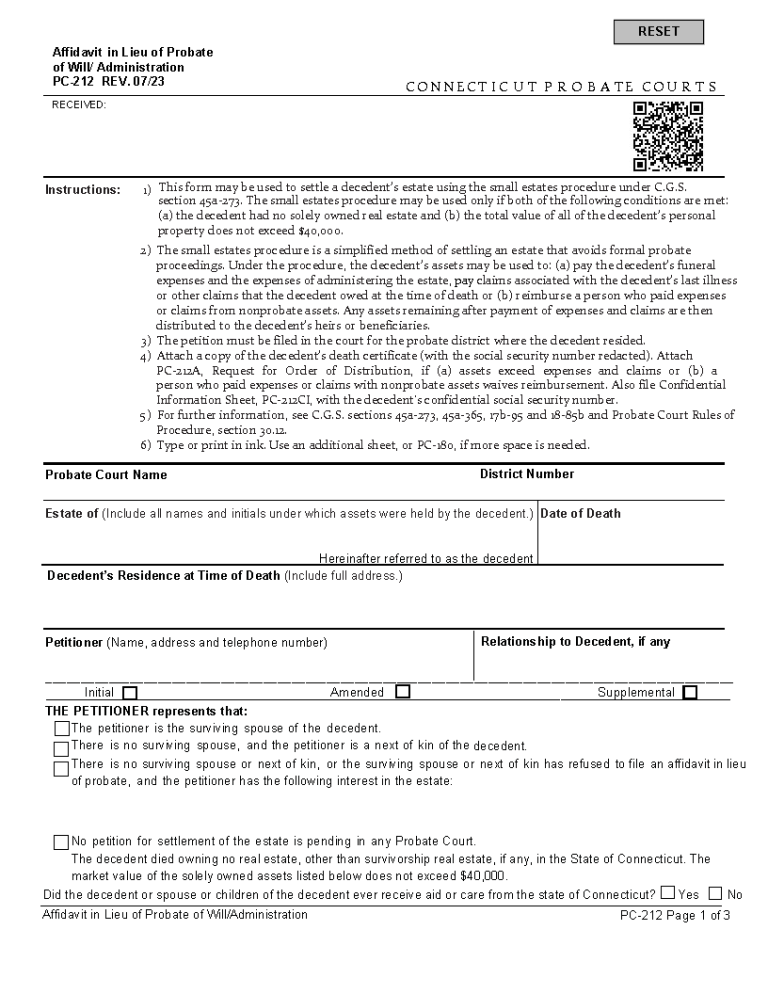
Complete the Affidavit in Lieu of Probate of Will/Administration (Form PC-212), listing the solely owned assets and their values, funeral and settlement expenses, taxes, and debts, along with the confidential supplement (Form PC-212CI). If assets exceed the listed expenses and claims, or reimbursement is waived, also complete the additional court form required to identify the persons entitled to the balance.[10]
Step 3 – Sign Under Penalty of False Statement
Sign the affidavit; the representations are made under penalty of false statement.[11]
Step 4 – File With the Probate Court
File the affidavit with the Probate Court for the district where the decedent resided. Use the court locator to identify the correct district.[12]
Step 5 – Receive the Court’s Decree
The Probate Judge issues a decree authorizing transfer of the assets, first to reimburse those who paid debts and expenses, then to the persons entitled. If the decedent received qualifying state aid, the court follows the additional state-notice requirements before issuing the decree.[13]
Sample
Download: PDF
Sources
- Conn. Gen. Stat. § 45a-273(a)
- Conn. Gen. Stat. § 45a-273(a)
- Conn. Gen. Stat. § 45a-273(a)
- Conn. Gen. Stat. § 45a-273(c)
- Conn. Gen. Stat. § 45a-440
- Conn. Gen. Stat. § 45a-437(a)
- Conn. Gen. Stat. § 45a-437(a)(4)
- Conn. Gen. Stat. § 45a-438(a)
- Conn. Gen. Stat. § 45a-273(a)
- Conn. Gen. Stat. § 45a-273(b)
- Conn. Gen. Stat. § 45a-273(a)
- Conn. Gen. Stat. § 45a-273(a)
- Conn. Gen. Stat. § 45a-273(e)
 Chat with a Lawyer