


 Create Document

 Adobe PDF
 Microsoft Word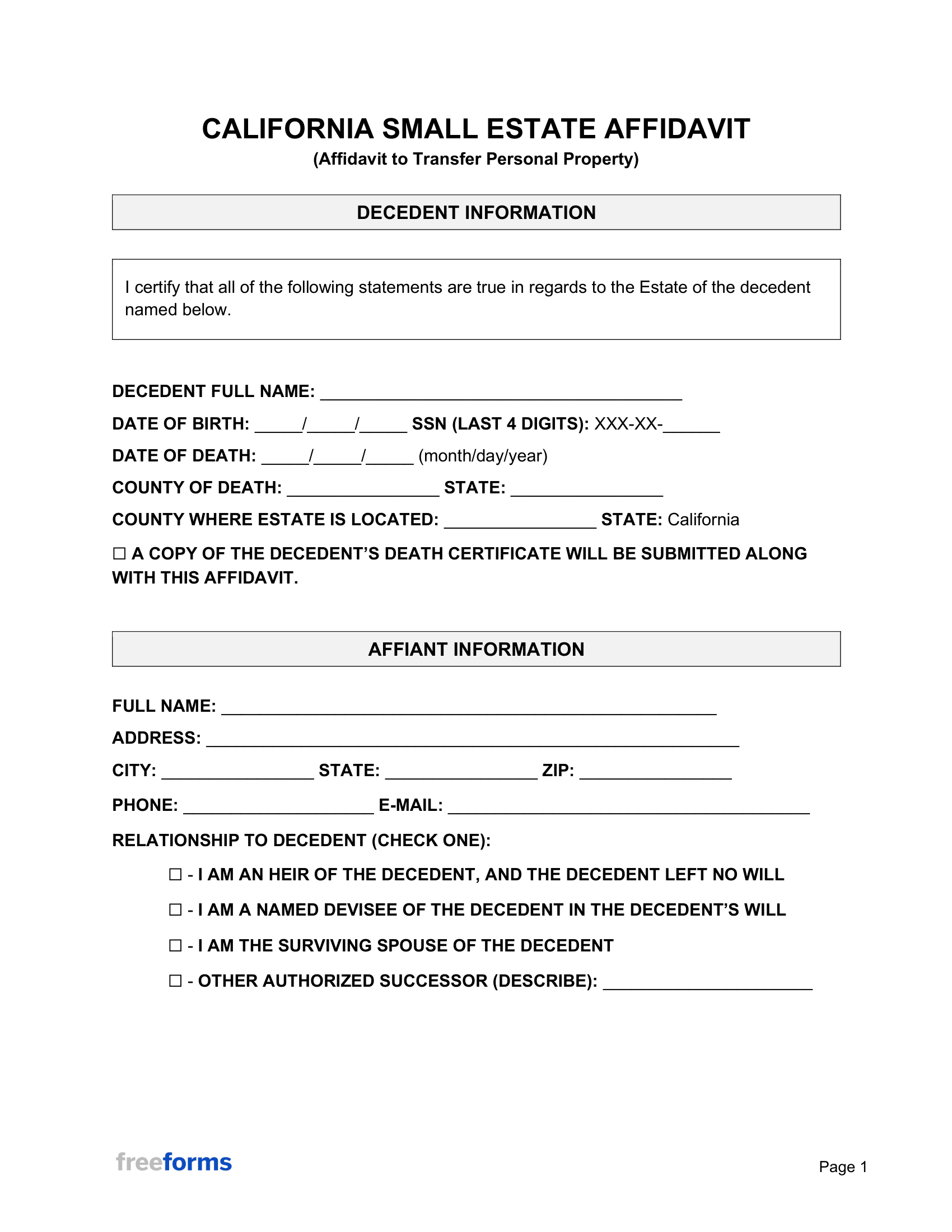
State Laws
- Maximum Amount: $208,850; this limit is adjusted for inflation every three years. [1][2]
- Signing Requirements: Signed under penalty of perjury; notarization is not required by statute, but some banks and institutions require it before releasing assets.[3]
- Where to File: The personal property affidavit is presented directly to the person or institution holding the asset (not filed with the court).[4][5]
- When to File: 40 days after death.[6]
- Survivor Requirements: A rightful heir must survive the decedent by at least 120 hours (5 days).[7]
Rightful Heirs (Hierarchy)
If the decedent did not have a will, the beneficiary hierarchy is as follows:
- Spouse: The surviving spouse keeps all community property.[8] For the decedent’s separate property, the spouse receives all of it if the decedent left no children, parents, siblings, or their descendants; one-half if the decedent left one child (or one deceased child’s descendants), or no children but a parent or sibling; and one-third if the decedent left more than one child.[9]
- No Spouse, Children: The separate property that does not pass to the spouse goes to the children equally, with a deceased child’s share passing to that child’s descendants. If there is no surviving spouse, the children take the entire estate.[10]
How to File a Small Estate
Step 1 – Wait the Required Period
For the personal-property affidavit, at least 40 days must pass after the death.[11][12]
Step 2 – Choose the Correct Procedure and Confirm the Value Limit
For a death on or after April 1, 2025, the statutory estate calculation for the personal-property affidavit must be $208,850 or less. Use the statutory exclusions when calculating the applicable limit; debts and mortgages generally are not subtracted from the gross-value calculation.[13][14]
Step 3 – Complete the Correct Document
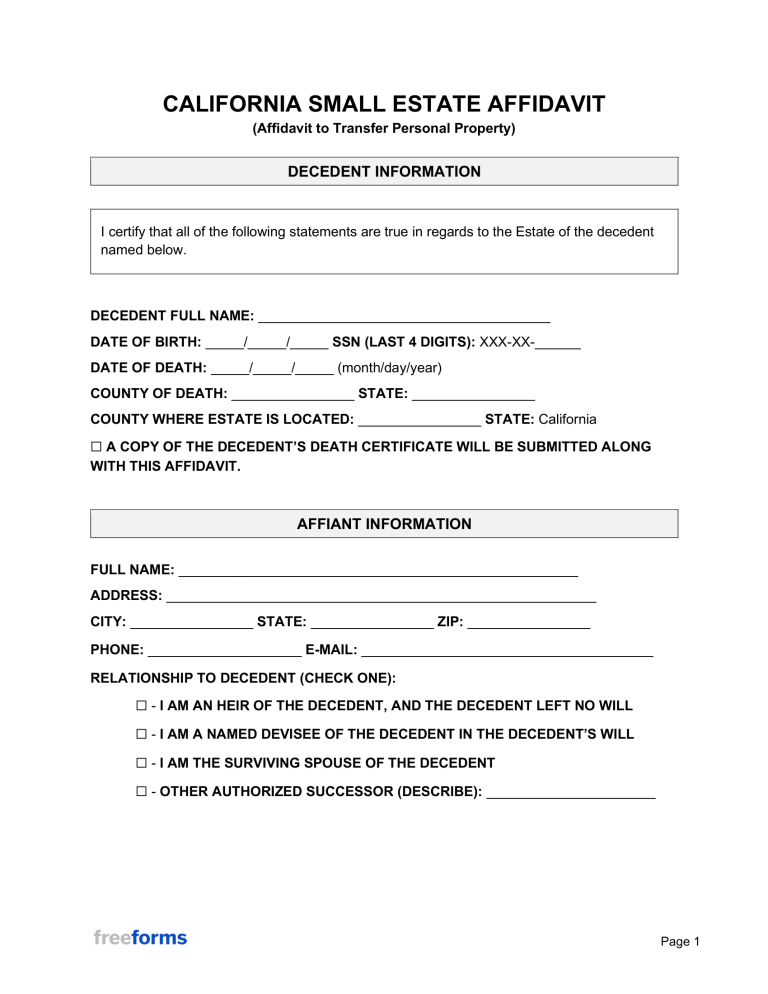
Prepare the affidavit required by Probate Code § 13101 for personal property.[15][16]
Step 4 – Attach the Supporting Documents
Attach a certified copy of the death certificate. Have a personal-property affidavit notarized if the holder of the asset requires notarization.[17][18]
Step 5 – Present or File the Document
Present the personal-property affidavit and death certificate to the bank, employer, or other asset holder.[19][20]
Sample
Sources
- Judicial Council of California (Probate Code § 890 Adjusted Dollar Amounts)
- Cal. Prob. Code § 13100
- Cal. Prob. Code § 13101(a)(11)
- Cal. Prob. Code § 13100
- California Courts Self-Help (Transfer a Small Estate Without Probate)
- Cal. Prob. Code § 13100
- Cal. Prob. Code § 6403
- Cal. Prob. Code § 6401(a)
- Cal. Prob. Code § 6401(c)
- Cal. Prob. Code § 6402(a)
- Cal. Prob. Code § 13100
- California Courts Self-Help (Transfer a Small Estate Without Probate)
- Judicial Council of California (Probate Code § 890 Adjusted Dollar Amounts)
- California Courts Self-Help (Transfer a Small Estate Without Probate)
- Cal. Prob. Code § 13101(a)
- California Courts Self-Help (Transfer a Small Estate Without Probate)
- Cal. Prob. Code § 13100
- California Courts Self-Help (Transfer a Small Estate Without Probate)
- Cal. Prob. Code § 13100
- California Courts Self-Help (Transfer a Small Estate Without Probate)
 Chat with a Lawyer