


 Create Document

 Adobe PDF
 Microsoft Word
Lease Agreements By Type (8)
 Association of Realtors Version: Tennessee’s regional realtor organization provides citizens with a lease agreement made for residential dwellings. Association of Realtors Version: Tennessee’s regional realtor organization provides citizens with a lease agreement made for residential dwellings.
Download: PDF |
 Commercial Lease Agreement: An express filing applicable to the renting of a unit for business usage. Commercial Lease Agreement: An express filing applicable to the renting of a unit for business usage.
Download: PDF, Word (.docx) |
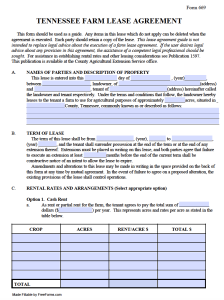 Farm Lease Agreement: A rental contract that is specific to the leasing of farmland. Farm Lease Agreement: A rental contract that is specific to the leasing of farmland.
Download: PDF |
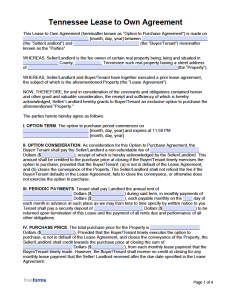 Lease to Own Agreement: Generates a format to cover the provisions of a rental of a building with a chance to buy upon the termination of the lease term. Lease to Own Agreement: Generates a format to cover the provisions of a rental of a building with a chance to buy upon the termination of the lease term.
Download: PDF, Word (.docx) |
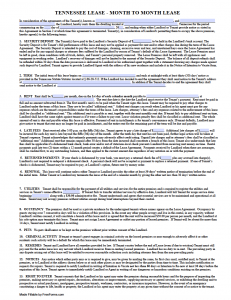 Month-to-Month Lease: The document incorporated to document the letting of an estate for a particular amount of time with an option to opt-out with thirty (30) days of advance communication of a desire to terminate. Month-to-Month Lease: The document incorporated to document the letting of an estate for a particular amount of time with an option to opt-out with thirty (30) days of advance communication of a desire to terminate.
Download: PDF |
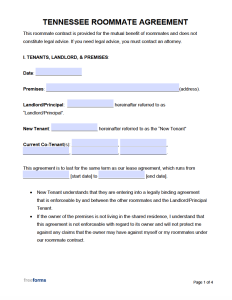 Roommate Agreement: Realizes the accord of an individual to rent a portion of a home and shared areas for a monthly stipend for a secured length of time. Roommate Agreement: Realizes the accord of an individual to rent a portion of a home and shared areas for a monthly stipend for a secured length of time.
Download: PDF, Word (.docx) |
|
Standard Lease Agreement Download: PDF, Word (.docx) |
 Sublease Agreement: A lease arrangement for a dwelling where a present tenant is to lease the residence to another individual. Sublease Agreement: A lease arrangement for a dwelling where a present tenant is to lease the residence to another individual.
Download: PDF, Word (.docx) |
Additional Forms
Required Landlord Disclosures
1.) Identification of the Landlord or Authorized Personnel (§ 66-28-302) – The names and addresses for the owner of the property must be appropriately divulged in the written lease agreement. Any authorized official serving to manage any required action for maintenance on the premises should be listed as well.
2.) Lead-Based Paint (40 CFR § 745.113): Buildings that have been constructed before 1978 may pose a hazard to any tenant residing on the property because of the possibility of on-site lead-compound paint. Literature disclosing the information on the hazardous impact of exposure should be included within the leasing document.
3.) Property Showings During Tenancy (§ 66-28-403) – To showcase the unit for future tenants during the current tenancy, a clause allowing for entry must be defined in the lease agreement. The landlord must follow regulation to permit the entrance of potential new tenants only during the last month before the lease ends and only with 24 hours advance notice.
When is Rent Due?
Grace Period: Counties under the Uniform Residential Landlord Tenant Act require a 5-day grace period; however, other counties do not (Tenn. Code Ann. § 66-28-201(d)).
Unpaid Rent: Regardless of the type of county, once rent becomes past due, landlords may issue a 14-day pay-or-quit notice. (Tenn. Code Ann. § 66-28-505(a)(1)).
Late fees
NSF Fees
Security Deposit Maximum ($)
Security Deposit Return
Returning to Tenant: In URLTA counties, landlords send notice of the deposit location to the tenants’ address; however, if the tenant does not respond within 60 days, the landlord retains it (Tenn. Code Ann. § 66-28-301(g)(1)).
Itemized List: Tenants retain the right to mutual inspection (within 4 days of move out) and an accounting of all deductions from the security (Tenn. Code Ann. § 66-28-301).
Landlord’s Right to Enter
Standard Entry: Tennessee does not explicitly require notice from landlords; however, it requires landlords to obtain tenant consent before entering (Tenn. Code Ann. § 66-28-403(a)).
Emergency Entry: Landlords do not need to give prior notice or gain consent whenever an emergency requires entry (Tenn. Code Ann. § 66-28-403(a)).
Absence
Landlords in ULTRA counties may declare tenant abandonment whenever either:
- The tenant’s rent is delinquent, and they have been absent for at least 30 days without explanation.
or
- The rent is 15 days overdue, and reasonable observations (e.g., multiple pieces of furniture and personal items are missing), the tenant does not answer a 10-day notice (TN Code § 66-28-102).
URLTA counties require landlords to post a 10-day notice of abandonment on the property in addition to mailing it (TN Code § 66-28-405).
Repair and Deduct
When Tenant Terminates (early)
Duty to Mitigate: Landlords must lower the damages of lost rent by re-renting the residence rather than letting it remain empty (Tenn. Code Ann. § 66-28-507(c)).
Domestic Violence: Victims issue a notice to terminate and vacate so long as:
- They provide a a copy of a protection order or evidence of a criminal charge (e.g., police report)
- They terminate the lease on a “mutually agreed-upon release date” that is within 30 days of the notice date (TN Code § 66-28-205) (TN Code § 66-28-504)
Active Military: Whenever military service members receive movement orders while in a lease, they terminate the lease, giving 30 days’ notice (50 USC 3955)
Landlord Noncompliance: Tenants give landlords 14 days to cure noncompliance with the lease before terminating accordingly (Tenn. Code Ann. § 66-28-501(a)).
Landlord Harassment: Tenants can use the courts to terminate the agreement or seek injunctive relief whenever landlords repeatedly abuse access (Tenn. Code Ann. § 66-28-403(a)).
Inhabitability: Tennessee tenants use a 14-day notice of noncompliance to quit or terminate whenever landlords maintain habitability ((Tenn. Code Ann. § 66-28-501(a)).
 Chat with a Lawyer