

Free Nebraska Rental Lease Agreement Templates (6) | PDF | Word

Nebraska Rental Lease Agreement Templates (6)

A Nebraska lease agreement predicates the facts surrounding a rental property. Within the contract, users can establish the fixed amount of time and money required for the tenant to occupy the space, as well as any other stipulations.

Last updated February 16th, 2026

A Nebraska lease agreement predicates the facts surrounding a rental property. Within the contract, users can establish the fixed amount of time and money required for the tenant to occupy the space, as well as any other stipulations.

  1. Home »
  2. Lease Agreements »
  3. Nebraska

Lease Agreements By Type (6)

Commercial Lease Agreement: Institutes a legal understanding for a business to rent a building for an intended time span.

Download: PDF, Word (.docx)

Lease to Own Agreement: Documents the exchange of right of use of a home for financial compensation. This particular lease has the added benefit of the first right of refusal for the lessee to purchase the residence upon completing the lease.

Download: PDFMS Word (.docx)

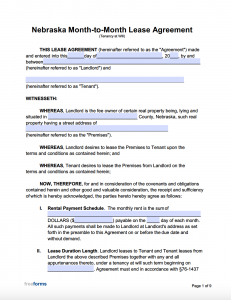
Month-to-Month Lease: Authorizes the extension of the use of a residential unit for a specified dollar amount and interval with an option to revoke at any time with thirty (30) days’ notice.

Download: PDF, Word (.docx)

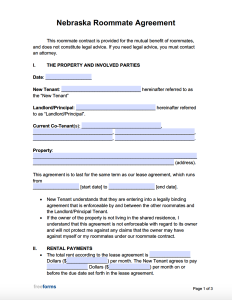
Roommate Agreement: Produces a written concurrence for one to employ the use of part of a dwelling for a designated period and price.

Download: PDF, Word (.docx)

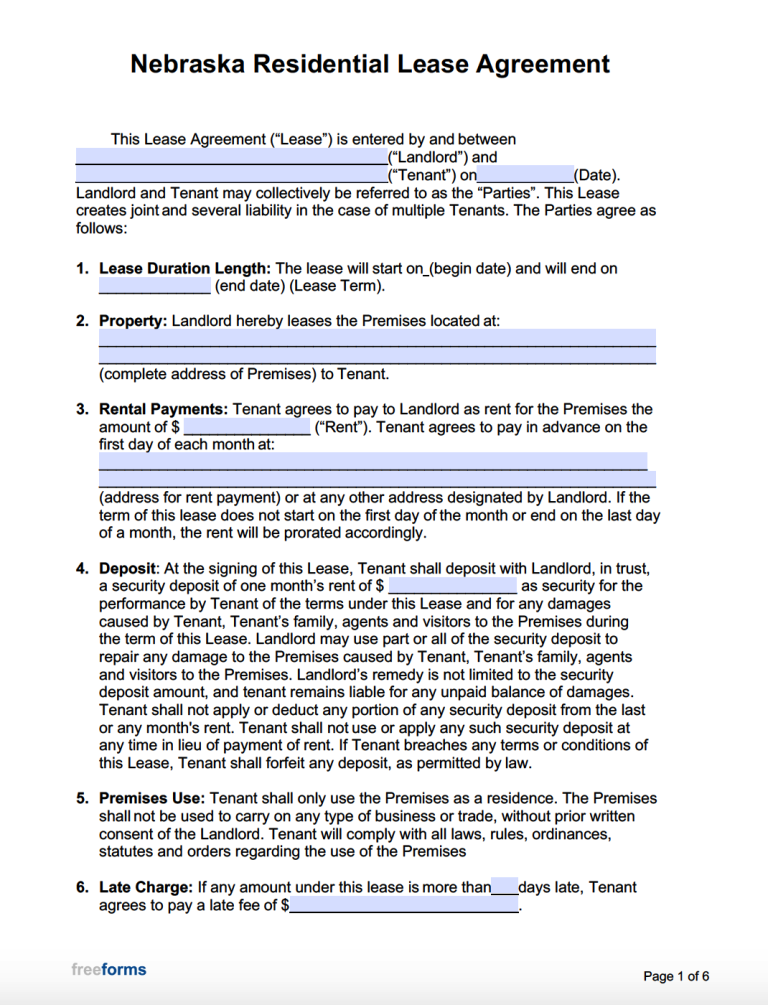
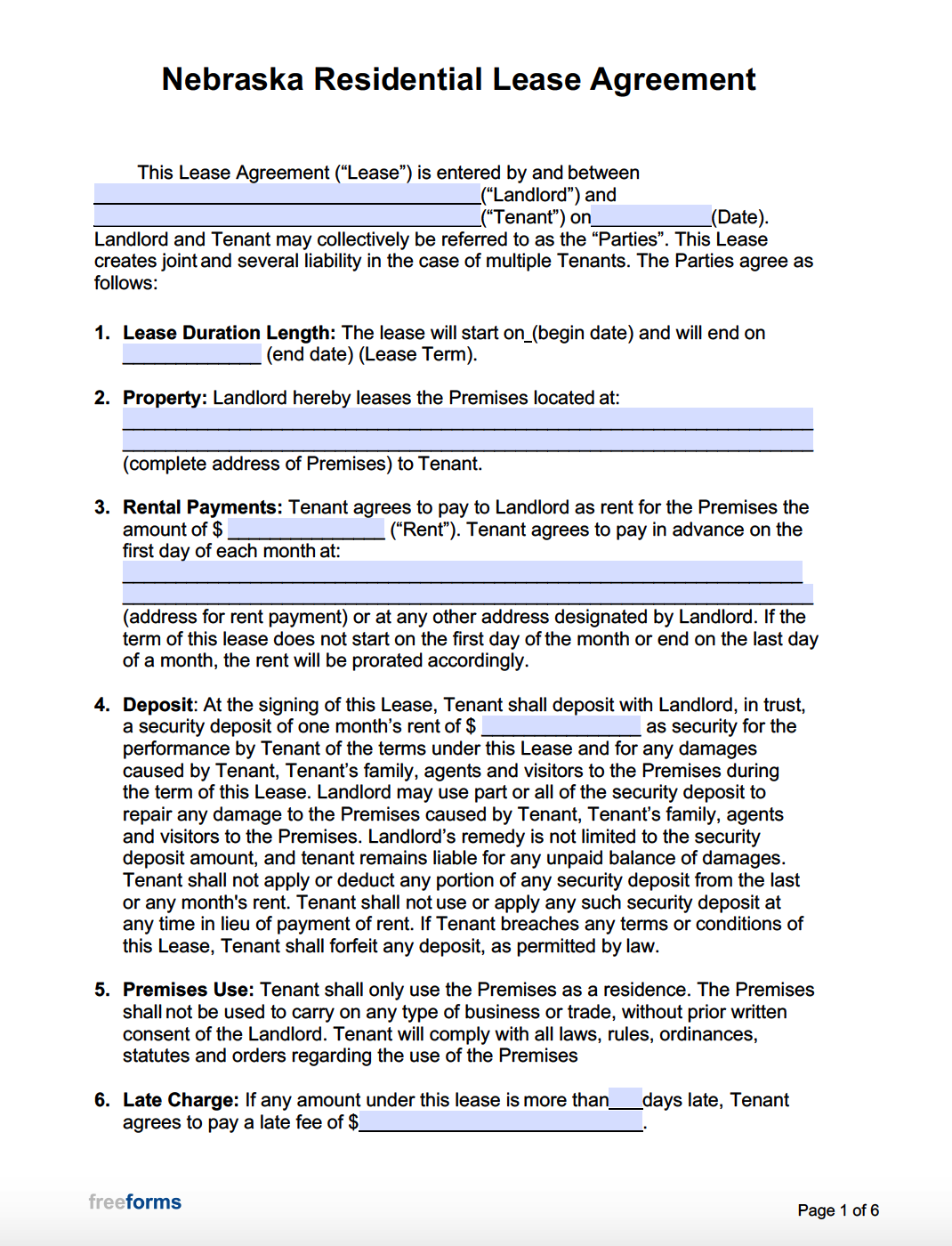
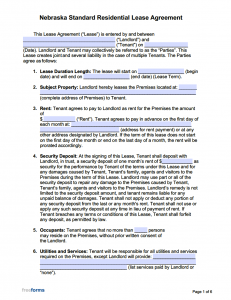
Standard Lease Agreement: Makes an official account of the terms and conditions connected with the leasing of a residential unit.

Download: PDF, Word (.docx)

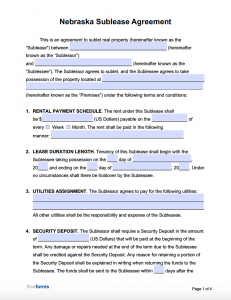
Sublease Agreement: Contracts a substituted entity to gain the right to live in a property granted from a current lessee.

Download: PDF, Word (.docx)

Required Landlord Disclosures

Identification of the Landlord or Authorized Personnel (§ 76-1417): The current address and name of any owner or managing administrator for the property must be brought to the attention of any possible tenant in writing before the signing of a contract.

Lead-Based Paint (42 U.S. Code § 4852d): Real estate constructed before 1979 may present the possibility of lead-based paint contamination. Proper safety measures and symptoms of contact with the substance are to be reviewed within the distributed informational materials to any potential tenant.

When is Rent Due?

Grace Period: Nebraska does not institute a statewide grace period and, in fact, leaves this entirely to the lease. (NE RS § 76-1414(3)).
Unpaid Period: Once the due date expires without payment, landlords may deliver a 7-day quit or pay notice. (Neb. Rev. Stat. § 76-1431(2))

Late Fees

Leases must set a late fee in order for the landlord to apply them, additionally, Nebraska does not set a limit on late fees (Neb. Rev. Stat. § 76-1414(1)).

NSF Fees

Landlords may assess a fee of $10 in addition to the check amount, as well as reasonable bank handling fees (Neb. Rev. Stat. § 28-611(5)).

Security Deposit Maximum($)

Nebraska strictly limits leases to 1 month’s rent; however, it may also assess a ¼ month’s rent as a security deposit (Neb. Rev. Stat. § 76-1416(1)).

Security Deposit Return

Return to Tenant: The landlord has 14 days to return the security deposit once the lease terminates. (Neb. Rev. Stat. § 76-1416(2)).
Itemized List: Nebraska requires that landlords explicitly a list of each deduction from the security deposit and the reason (Neb. Rev. Stat. § 76-1416(2)).

Landlord’s Right to Enter

Standard Entry: Tenants must receive 24 hours’ notice before landlord entry; however, they may not “unreasonably withhold consent” (Neb. Rev. Stat. § 76-1423(3)(a)–(b)).
Emergency Entry: While the landlord must respect the tenant’s privacy, they may enter during emergencies without notice (Neb. Rev. Stat. § 76-1423(3)(a)–(b)).

Absence

Landlords consider tenant abandonment whenever observing a total absence for (the lesser of) thirty days or a full rental period. (Neb. Rev. Stat. § 76-1432(3)).

Repair and Deduct

The tenant issues a 30-day notice to quit that explicitly demands repairs in 14 days, after which they seek injunctive relief (Neb. Rev. Stat. § 76-1425(1)–(2)).

Tenant Breaking a Lease (Early)

Duty To Mitigate: Landlords must make a reasonable attempt to minimize the loss as a result of tenant abandonment (e.g., rent loss) (NE RS § 76-1405).
Military Service: Service members terminate with 30 days’ notice whenever they must move or vacate to obey deployment (or transfer) orders (50 USC 3955).
Landlord Noncompliance: Tenants issue a 30-day notice to repair or quit where, unless the repairs are complete within 14 days, the lease will terminate accordingly (NE RS § 76-1425).
Domestic Violence: Victims terminate by notice (14-30 days); however, are still liable for that month’s rent and:

  • Must supply supportive documentation from a health institute (e.g., medical, mental, or victim services)
  • Provide court orders, as well as restraining orders, and other legal instruments that solidify a domestic violence incident
  • The state explicitly restrains perpetrators from enjoying such termination rights.

Landlord Harassment: Whenever landlords abuse their entry rights, tenants may seek injunctive relief from the courts (NE RS § 76-1438).
Inhabitability: Landlords are explicitly responsible for remaining in compliance with all health and safety codes while providing essential services and are liable to a 30-day termination notice otherwise (NRS 76-1425).

Is an Oral Lease enforceable?

An oral lease must be put in writing in order to remain effective for longer than one year (Neb. Rev. Stat. § 36-105)

Renewing a Lease

Nebraska clearly prohibits individual counties from enacting any rent control laws during lease renewals or otherwise (NE Code § 13-331).

Unclaimed Property

Landlords issue a 7-day notice, which includes an inventory, to the tenant’s latest address to retrieve their property accordingly (Neb. Rev. Stat. §§ 69-2303).

Landlord-Tenant Laws

The Nebraska Uniform Residential Landlord and Tenant Act (§ 76.1401 – § 76.14,111) specifically dissects the full range of regulations on the state level pertaining to lessee/lessor circumstances.
Comments