


 Create Document

 Adobe PDF
 Microsoft Word
State Laws
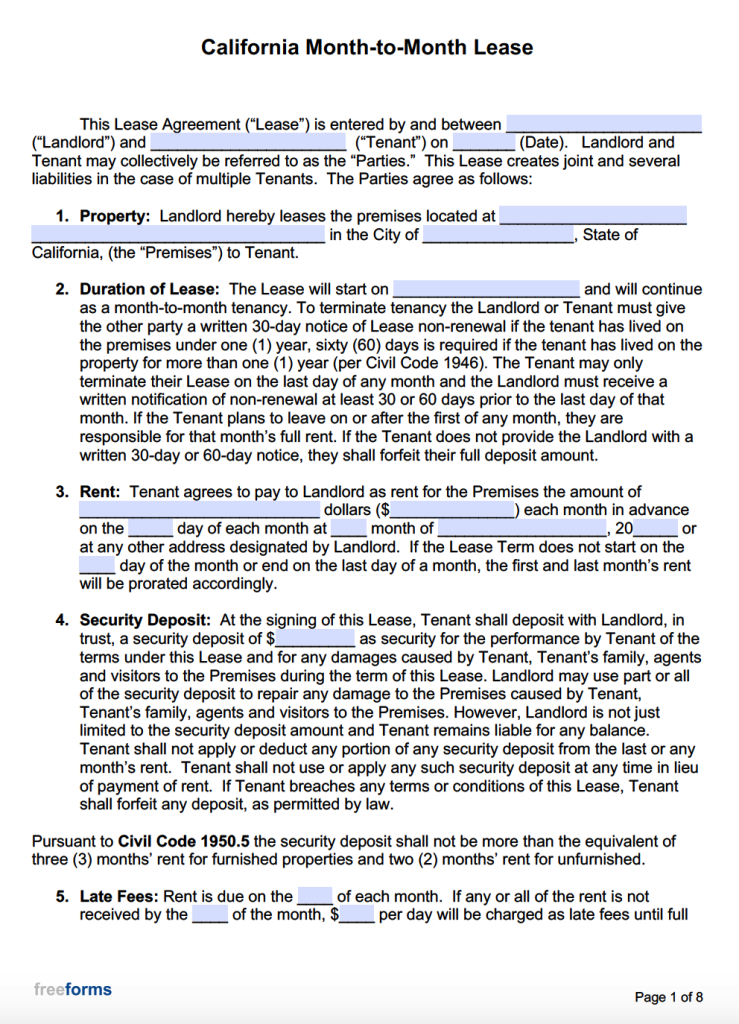
Minimum Termination: A tenant must provide at least 30 days’ written notice to terminate the lease (§ 1946.1(b)). A landlord must provide 30 days’ written notice if the tenant has occupied the property for less than one year (§ 1946.1(c)). Landlords are required to give 60 days’ notice if all tenants have lived there for one year or longer, with a 30-day exception if the landlord is selling a separately alienable property (like a single-family home or condo) to a bona fide purchaser who intends to move in (Cal. Civ. Code § 1946.1(d)).
Increasing Rent: Annual rent increases are capped statewide under the Tenant Protection Act at 5% plus the local Consumer Price Index (CPI), or a maximum of 10% total, whichever is lower (§ 1946.1(d)). Many cities and counties in California enforce stricter rent-control caps that supersede the state limit. A landlord must provide 30 days’ written notice before increasing the rent by 10% or less (§ 827(b)(2)), and 90 days’ notice for an increase exceeding 10% if the property is legally exempt from state and local rent caps (§ 827(b)(3)(A)).
Rent Cap Exemptions: Under California’s Tenant Protection Act, some properties are exempt from state rent caps, provided a mandatory written notice is given to the tenant before the lease is signed (§ 1947.12(d)). Exempt properties include:
- Housing built within the last 15 years
- Owner-occupied duplexes
- Deed-restricted affordable housing
- Single-family homes or condos not owned by a corporate entity
Furthermore, the Costa-Hawkins Rental Housing Act prohibits local municipalities from applying their stricter rent control ordinances to single-family homes, condominiums, or any housing constructed after February 1, 1995 (§ 1954.52(a)).
Sample
Download: PDF, MS Word (.docx)
 Chat with a Lawyer